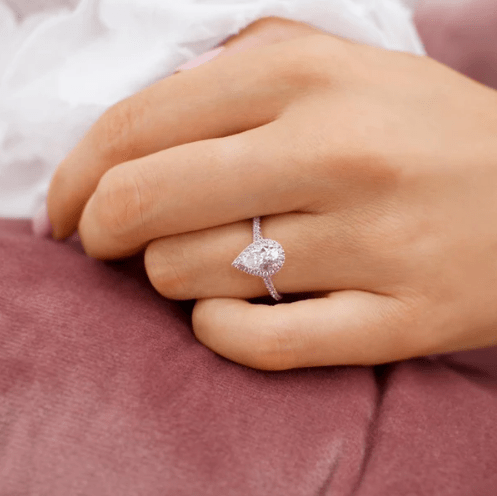
The rise of the pear shape diamond in 2026 is not the result of a fleeting trend or a single cultural moment. It is the culmination of more than a decade of shifting values in how engagement rings are chosen, worn and understood. Where diamond shape preference was once dictated by tradition and marketing hierarchy, it is now driven by confidence, individuality and intention. Within this landscape, the pear shape has emerged as the most expressive and adaptable choice of its era.
Diamond shapes have always reflected their time. In periods where conformity and permanence were prioritised, symmetrical cuts dominated. In moments where self-expression and nuance gained cultural ground, more characterful silhouettes began to rise. The pear shape belongs firmly to the latter category. Its ascent in 2026 signals not rebellion against tradition, but a recalibration of what tradition means.
The pear shape diamond is a hybrid cut, combining the brilliance of the round with the elongation of the marquise. This duality has always made it intriguing, but historically it also made it difficult to categorise. For much of the twentieth century, engagement ring culture favoured clarity of message. Round meant classic. Princess meant modern. Anything that resisted easy definition was often sidelined.
Historical records referenced by the Gemological Institute of America show that the pear shape was first developed in the fifteenth century following advances in diamond cutting. From its inception, it represented innovation rather than convention. It was never designed to be uniform. It was designed to be expressive.
Despite this early innovation, the pear shape spent centuries appearing primarily in high jewellery rather than engagement rings. Its asymmetry made it emotionally resonant but culturally risky in a space dominated by ideals of balance and perfection. Engagement rings, particularly in the twentieth century, became increasingly symbolic of stability and predictability.
The post-war dominance of the round brilliant diamond reinforced this hierarchy. As marketing positioned symmetry and sparkle as the ultimate markers of love, alternative shapes were framed as stylistic detours rather than equal choices. The pear shape, despite its beauty, was often described as unconventional.
That language mattered.
It began to shift in the early 2010s, as engagement ring culture started to loosen. Buyers became less interested in proving commitment through conformity and more interested in choosing rings that reflected personal taste. Elongated shapes began to gain traction, offering a different visual rhythm without abandoning brilliance.
Early editorial coverage in Vogue UK played a quiet but influential role in this transition. Pear shape diamonds were no longer framed as unusual. They were described as elegant, directional and intentional. This reframing allowed the shape to re-enter the conversation on new terms.
By the late 2010s, the criteria by which engagement rings were judged had shifted significantly. Size became less important than proportion. Sparkle mattered, but so did wearability. Rings were no longer chosen solely for the proposal moment, but for the decades that followed.
The pear shape excelled under this new scrutiny.
One of the most compelling reasons pear shape diamonds have surged ahead of other elongated cuts in 2026 is their visual efficiency. The tapered silhouette creates the impression of length and presence without requiring excessive carat weight. In a market increasingly conscious of balance rather than excess, this quality has become highly desirable.
Luxury analysis in Financial Times How To Spend It has highlighted how contemporary luxury is defined by intelligent restraint rather than overt display. The pear shape aligns perfectly with this philosophy. It feels generous without being indulgent.
Unlike the oval, which maintains symmetry, the pear shape introduces direction. This directional quality gives the ring a sense of movement. It interacts with the hand rather than sitting passively upon it. In 2026, this sense of dynamism resonates strongly with buyers who want jewellery that feels alive.
Design commentary in Wallpaper* has explored how modern aesthetics increasingly favour forms that suggest motion rather than stasis. Pear shape diamonds embody this shift. Their asymmetry creates visual interest without overwhelming the design.
Versatility is another defining factor in the pear shape’s rise. Where some diamond shapes dictate specific settings, the pear shape invites interpretation. It can be worn point up or point down. It can anchor minimalist solitaires or lend softness to architectural bands. It adapts effortlessly to modern east-west settings as well as traditional orientations.
This adaptability has made the pear shape a favourite among contemporary designers. In 2026, pear shape engagement rings appear across a wide spectrum of styles, from understated to sculptural. The shape no longer signals a niche aesthetic. It signals confidence.
Cultural analysis in The Guardian has noted how modern consumers increasingly reject standardisation in favour of objects that feel personal. Engagement rings are central to this shift. The pear shape offers individuality without eccentricity.
Another reason for the pear shape’s dominance lies in changing attitudes towards symmetry. For much of the twentieth century, symmetry was equated with perfection. In contemporary design culture, subtle irregularity is increasingly viewed as a sign of sophistication.
The pear shape occupies a rare middle ground. It is neither perfectly symmetrical nor overtly irregular. This balance appeals to buyers who value nuance. It feels organic rather than engineered.
Fashion analysis in Harper’s Bazaar UK has explored how organic silhouettes have become synonymous with modern elegance. Pear shape diamonds align naturally with this aesthetic, offering softness without informality.
Practicality has also influenced demand. When designed well, pear shape engagement rings can be set lower on the finger than many high-profile cuts. This improves comfort and security, both of which are increasingly prioritised as engagement rings are worn continuously.
Cultural insight from BBC Culture has shown how modern expressions of commitment prioritise authenticity and longevity. Rings are no longer ceremonial objects. They are daily companions. Shapes that support this reality rise naturally in popularity.
Technological advances have further supported the pear shape’s ascent. Historically, pear shape diamonds could suffer from uneven shoulders or poor light performance if cut inconsistently. Improvements in cutting precision have largely eliminated these issues.
The Gemological Institute of America has documented how advancements in diamond cutting have improved the consistency and brilliance of complex shapes. As quality became more reliable, confidence in pear shape diamonds grew.
Ethical considerations have also played a role. As lab grown diamonds become mainstream, buyers are increasingly conscious of how visual impact relates to resource use. The pear shape offers a larger visual footprint per carat, aligning with more mindful consumption.
Brands such as Lily Arkwright reflect this shift, frequently showcasing pear shape diamonds within collections that prioritise ethical sourcing and contemporary design. The shape fits seamlessly into a future-facing engagement ring philosophy.
Celebrity influence has contributed to normalisation rather than imitation. High-profile pear shape engagement rings have demonstrated the cut’s versatility across styles, from minimalist to expressive. Rather than dictating taste, they have broadened acceptance.
Media coverage in Elle UK increasingly frames pear shape diamonds as modern and refined rather than unconventional. This shift in language reinforces confidence, allowing buyers to choose the shape without feeling they are stepping outside tradition.
In 2026, pear shape diamonds also benefit from exceptional adaptability across metals and band widths. They complement yellow gold, platinum and mixed metal designs equally well. Their silhouette balances slim bands and more substantial profiles with ease.
This adaptability supports longevity. As personal style evolves, the ring remains relevant. This long-term perspective has become central to engagement ring decisions.
Market insight from McKinsey & Company has shown that modern luxury consumers value durability and adaptability over novelty. Engagement rings exemplify this shift. Shapes that age well naturally rise in demand.
Looking ahead, the pear shape’s prominence does not imply uniformity. Rather, it reflects a pluralistic market where choice is guided by meaning rather than hierarchy.
The pear shape has risen because it offers balance. It is expressive without being theatrical. Distinctive without being divisive.
Historically, diamond shape trends have always mirrored cultural confidence. When buyers feel constrained, they choose safety. When they feel empowered, they choose expression.
The rise of the pear shape in 2026 signals assurance. Buyers are comfortable choosing rings that reflect who they are rather than what tradition dictates.
That is why the pear shape diamond is not simply fashionable in 2026.
It is emblematic.
It represents a generation of buyers who value nuance, individuality and intention.
And that is why, in 2026, the pear shape has become one of the most in-demand engagement ring shapes in the UK.
 Diamonds are a girls best friend
Leave a comment