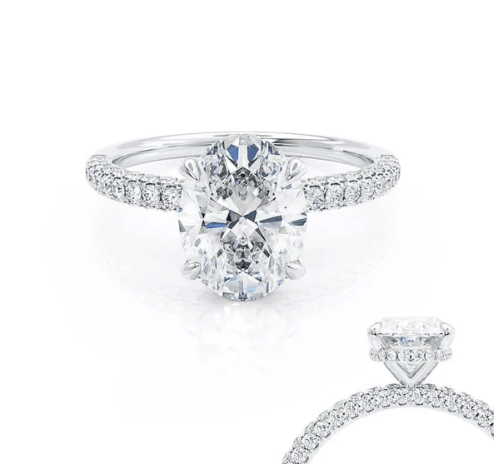
Diamond melee is one of the most influential yet least discussed elements in fine jewellery. These small diamonds rarely take centre stage, but they shape how jewellery looks, feels and performs. From antique settings to contemporary engagement rings, diamond melee has played a quiet but decisive role in defining refinement, balance and craftsmanship.
To understand diamond melee properly, it is essential to look at both its technical meaning and its historical development. Melee diamonds are not simply small stones. They are a design language, one that has evolved alongside jewellery itself.
The term melee originates from the French word mêlée, meaning mixture or medley. In gemmological terms, diamond melee refers to small diamonds, traditionally under 0.20 carats, that are used collectively rather than individually. They are selected to work together visually, creating texture, light and continuity rather than focal impact.
Educational definitions published by the Gemological Institute of America explain that melee diamonds are typically used as accents, pavé surfaces or supporting elements around larger stones. Their purpose is not to dominate attention, but to enhance structure and light flow.
While the terminology is relatively modern, the use of small diamonds in jewellery is centuries old. Early diamond jewellery often relied on clusters of small stones because cutting larger diamonds was technologically challenging and financially restrictive.
In medieval Europe, diamonds were rare and difficult to shape. Early stones were often irregular, set in closed-back settings to maximise perceived brightness. Jewellery from this period frequently used multiple small diamonds to create visual impact rather than relying on a single centrepiece.
Research from the British Museum shows that early diamond jewellery often employed groupings of stones to convey wealth and power. Size was less important than presence. Multiple diamonds signalled abundance and status, particularly among royalty and the nobility.
As cutting techniques improved during the Renaissance, diamonds became more refined, but large stones remained scarce. Small diamonds were more accessible and easier to integrate into elaborate designs. This period saw the rise of cluster jewellery, where multiple stones were arranged to form floral, geometric or symbolic motifs.
Art historical analysis from the Victoria and Albert Museum highlights how Renaissance and Baroque jewellery used repetition of small stones to create rhythm and ornamentation. Diamonds were valued not only for sparkle, but for how they could articulate form.
The eighteenth century marked an important shift in how small diamonds were used. Advances in rose cutting allowed stones to reflect more light, and jewellery design began to emphasise surface shimmer rather than mass. Melee diamonds became tools for creating light across a piece rather than concentrated brilliance.
During the Georgian era, diamonds were often set in silver-topped gold to enhance brightness in candlelight. Small stones were arranged closely together, foreshadowing techniques that would later be described as pavé. These early uses of melee were labour intensive and required exceptional craftsmanship.
Historical jewellery studies published by the Metropolitan Museum of Art show that Georgian jewellery relied heavily on small diamonds to achieve elegance and luminosity. The cumulative effect of melee created softness and refinement that large stones alone could not provide.
The nineteenth century saw diamond melee become even more prominent. As diamond sources expanded and cutting became more efficient, small diamonds became more widely available. Victorian jewellery embraced intricate detail, symbolism and texture, all of which suited melee diamonds perfectly.
Melee diamonds were used to outline motifs, add sparkle to engraved surfaces and frame larger gemstones. Their role was supportive but essential. Without them, much of the era’s jewellery would have lost its depth and richness.
Design commentary from the Royal Collection Trust notes that Victorian jewellery often relied on contrast between polished metal and diamond surfaces. Melee diamonds were central to achieving this visual balance.
The early twentieth century brought a fundamental change in jewellery aesthetics. Art Deco design favoured geometry, symmetry and precision. This was a defining moment for diamond melee as a structural element rather than decorative excess.
Art Deco jewellery used rows of small diamonds to create clean lines and architectural forms. Melee diamonds became tools of definition, outlining shapes and reinforcing symmetry. Their uniformity was essential to the era’s visual language.
Curatorial analysis from the Cooper Hewitt Smithsonian Design Museum explains how small diamonds were used in Art Deco pieces to emphasise order and modernity. Melee allowed designers to work with scale and proportion in new ways.
By the mid twentieth century, diamond melee had become firmly embedded in fine jewellery practice. As jewellery became more wearable and less ceremonial, melee offered a way to add refinement without overwhelming the wearer.
This period also saw the rise of pavé settings, where small diamonds are set closely together with minimal visible metal. Pavé relies entirely on melee diamonds and precise craftsmanship. The technique creates a continuous surface of sparkle that feels luxurious yet restrained.
Technical guidance from the International Gemological Institute highlights how pavé settings demand consistent stone quality and exacting setting standards. Melee diamonds must match closely in colour, cut and size to achieve the desired effect.
In engagement ring design, melee diamonds transformed how rings were perceived. Instead of a single centre stone standing alone, designers began to use small diamonds to enhance bands, halos and shoulders. This allowed for greater complexity and personalisation without altering the core symbolism of the ring.
Cultural commentary in Vogue has noted that modern bridal jewellery increasingly values detail and texture over overt scale. Melee diamonds play a key role in this shift, offering richness without excess.
Beyond engagement rings, melee diamonds became essential to everyday fine jewellery. Bracelets, necklaces and earrings rely on small diamonds to create fluidity and continuity. In many cases, the overall impression of luxury comes not from one stone, but from the collective presence of many.
Exploring modern diamond jewellery reveals just how central melee diamonds have become to contemporary design. They shape surfaces, define edges and soften transitions between metal and gemstone.
Symbolically, diamond melee represents a different kind of value. Unlike a centre stone, which often carries explicit meaning, melee diamonds work quietly. Their significance lies in cohesion and support. They demonstrate how many small elements can create something refined and enduring.
Sociological analysis from the Pew Research Center suggests that modern consumers increasingly appreciate craftsmanship and detail rather than overt display. Melee diamonds align with this preference, offering subtlety and depth.
From a future-facing perspective, diamond melee continues to evolve. Advances in cutting precision and ethical sourcing have expanded possibilities for consistent, high-quality small diamonds. Designers now treat melee not as filler, but as a primary design tool.
Design analysis from Dezeen has observed that contemporary jewellery increasingly values texture and material interaction. Melee diamonds allow designers to explore these ideas while maintaining elegance and wearability.
The enduring appeal of diamond melee lies in its adaptability. It works across styles, eras and contexts. Whether framing a centre stone or forming an entire surface, melee diamonds enhance without dominating.
They are proof that scale is not the sole measure of impact.
From medieval clusters to modern pavé, diamond melee has shaped the visual language of fine jewellery for centuries. It has moved from necessity to choice, from ornament to structure.
Today, diamond melee is not an afterthought. It is a deliberate design decision, reflecting an appreciation for balance, craftsmanship and subtle beauty.
In a world increasingly drawn to considered luxury, diamond melee feels more relevant than ever.
Small stones, used with intention, creating lasting meaning.
That is the quiet power of diamond melee.
 Diamonds are a girls best friend
Leave a comment