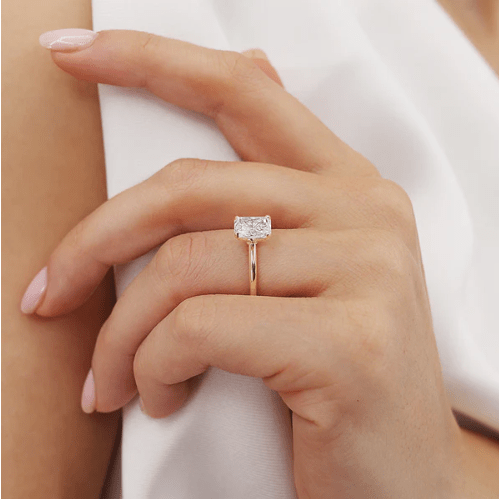
The radiant cut diamond has become one of the clearest expressions of how engagement ring design has evolved in recent years. It feels deliberate rather than traditional, confident rather than showy and contemporary without being stark. As modern couples increasingly seek rings that reflect both aesthetic intelligence and real-life wearability, the radiant cut has emerged as a natural fit.
This sense of belonging is not accidental. The radiant cut sits at the intersection of structure and sparkle, offering a balance that resonates strongly with today’s engagement ring values. It reflects a wider cultural shift away from rigid definitions of luxury and towards designs that feel thoughtful, versatile and emotionally grounded.
Unlike many classic diamond cuts whose histories stretch back centuries, the radiant cut is a modern creation. It was developed in the late twentieth century, specifically to answer a design problem that had not previously been resolved. How to combine the clean geometry of step-cut diamonds with the brilliance of round cuts.
Technical histories from the Gemological Institute of America explain that the radiant cut was one of the first square and rectangular diamonds to feature brilliant-style faceting. This innovation allowed it to deliver exceptional light performance while retaining a crisp, architectural outline. From the outset, the cut was designed to bridge categories rather than sit neatly within one.
That hybrid identity is central to its appeal today.
Modern engagement rings are rarely chosen in isolation from lifestyle. Rings are worn daily, photographed often and expected to feel relevant over decades rather than seasons. In this context, extreme softness or excessive formality can feel limiting. The radiant cut avoids both.
Its straight edges give it presence and clarity, while its faceting ensures warmth and sparkle. This combination feels particularly aligned with contemporary tastes, which favour intention over ornamentation and balance over excess.
Fashion commentary in Vogue UK has observed a move towards engagement rings that feel architectural but still expressive. Radiant cut diamonds sit comfortably within this space. They look purposeful rather than decorative, yet never feel cold or severe.
One of the reasons the radiant cut integrates so seamlessly into modern engagement ring design is its flexibility of proportion. It can be cut in square or rectangular formats, allowing buyers to choose a silhouette that suits their hand shape and personal style.
Rectangular radiant cuts offer elongation, subtly lengthening the finger in a way similar to oval or emerald cuts. Square radiant cuts, by contrast, deliver symmetry and visual weight without the softness associated with cushion cuts. Both retain the same faceting style, meaning brilliance remains a constant regardless of outline.
This adaptability supports a broader shift in engagement ring culture. Rings are no longer selected from rigid templates. They are chosen to feel personal. The radiant cut lends itself naturally to this bespoke mindset.
Durability has also become a central consideration in modern engagement rings. As rings are worn continuously, buyers are increasingly aware of practical details. The radiant cut’s trimmed corners reduce vulnerability to chipping compared to shapes with sharp points, making it well suited to everyday wear.
Luxury analysis in The Financial Times has highlighted how contemporary luxury places greater emphasis on longevity and function. Engagement rings are no longer just symbolic. They are functional objects expected to integrate into daily routines. The radiant cut’s robust structure supports this expectation.
Brilliance remains important, but its role has changed. Rather than seeking maximum sparkle at all costs, modern buyers tend to favour controlled brilliance that feels refined. The radiant cut’s faceting pattern delivers strong light return without overwhelming the design.
Jewellery features in Harper’s Bazaar UK have noted a growing preference for diamonds that sparkle confidently but subtly. Radiant cuts achieve this balance particularly well. They catch the light from multiple angles, yet their geometric outline grounds the effect.
The rise of lab grown diamonds has further reinforced the radiant cut’s relevance. Lab grown stones have enabled buyers to prioritise cut quality, proportion and overall design rather than compromise due to cost. As a result, performance-driven cuts like the radiant have seen increased demand.
A high-quality radiant cut lab diamond offers exceptional brilliance, modern structure and ethical clarity. This combination aligns closely with how contemporary engagement rings are being chosen. Not as status symbols, but as considered personal objects.
Within modern collections, the radiant cut lab diamond has become a centrepiece rather than an alternative. Its ability to deliver both sparkle and structure makes it particularly attractive to couples who want a ring that feels modern without being experimental.
Another reason the radiant cut feels so at home in modern engagement rings is its ability to bridge differing tastes. Engagement ring decisions are increasingly collaborative. The radiant cut appeals to those who love clean lines and those who prioritise sparkle, making it an effective compromise that does not feel like one.
Design-focused publications such as Wallpaper* have highlighted how contemporary jewellery often draws inspiration from architecture. Radiant cut diamonds, with their defined edges and balanced symmetry, feel inherently architectural. They sit comfortably in minimalist, sculptural and design-led settings.
At the same time, the brilliance of the cut ensures the ring retains warmth and romance. This balance is crucial. Modern engagement rings are expected to feel intentional without sacrificing emotional resonance.
There is also a shift away from heavily gendered jewellery aesthetics. Modern engagement rings are chosen for personal meaning rather than traditional coding. The radiant cut’s geometry and sparkle exist outside rigid associations, making it appealing across a broad spectrum of styles.
Cultural commentary in The Guardian has explored how consumers increasingly reject binaries in favour of nuance. The radiant cut embodies this approach. It is neither purely classic nor overtly modern. Neither soft nor severe. It exists comfortably between categories.
Visual culture has also played a role in the radiant cut’s rise. Engagement rings are frequently photographed and shared, making performance on camera an important consideration. Radiant cuts retain their shape and sparkle under varied lighting conditions, translating well across images and video.
Fashion media such as Elle UK has noted that diamonds with defined outlines often read more clearly on screen. Radiant cuts maintain their identity in a way that softer shapes sometimes struggle to do.
Despite its contemporary appeal, the radiant cut does not feel fleeting. Its design is rooted in technical innovation rather than trend. This distinction is important for buyers who want reassurance that their ring will age gracefully.
Market insight from McKinsey & Company shows that modern luxury consumers value adaptability and longevity. The radiant cut supports both. It works equally well in pared-back solitaires, hidden halo designs and bold, sculptural settings.
This adaptability allows engagement rings to evolve alongside personal style. Radiant cut rings can be reset or paired with different wedding bands over time without losing coherence. This flexibility matters to couples who see their ring as a lifelong companion rather than a static symbol.
In many ways, the radiant cut mirrors modern engagement ring culture itself. It blends tradition with innovation, clarity with expression and design with practicality. It avoids extremes in favour of balance.
That balance is why the radiant cut feels so naturally at home in modern engagement rings.
It reflects how couples approach commitment today. Thoughtfully, collaboratively and with confidence. It offers sparkle without spectacle and structure without rigidity.
As engagement ring design continues to evolve, the radiant cut is unlikely to fade from relevance. Its appeal is not tied to a passing trend, but to enduring priorities that continue to shape modern choices.
Modern engagement rings are about intention. The radiant cut expresses that intention through form, function and feeling.
That is why it does not simply appear in modern engagement rings.
It belongs there.
 Diamonds are a girls best friend
Leave a comment