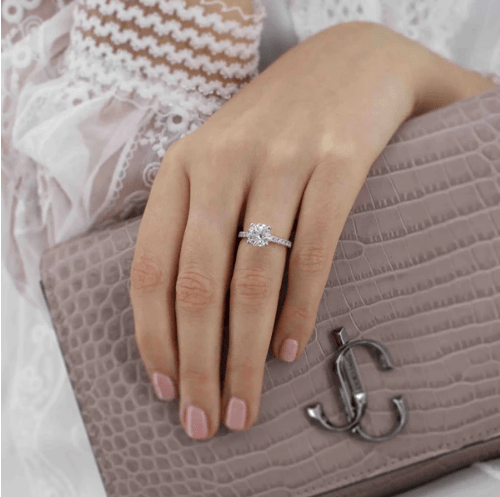
As engagement ring culture moves further into the mid-2020s, the conversation around stone choice has become more refined, more informed and more emotionally nuanced. Moissanite and lab grown diamonds are often grouped together as modern alternatives, yet their paths are diverging in meaningful ways. By 2026, the question is no longer which stone offers the most sparkle for the price, but which one best reflects how couples understand commitment, permanence and value today.
Over the last decade, engagement ring decisions have shifted away from inherited rules and towards intentional choice. Buyers are researching materials, questioning long-held assumptions and thinking carefully about how a ring will feel not just on the day of a proposal, but years into a shared life. This change in mindset has reshaped the way moissanite and lab grown diamonds are perceived.
Moissanite first gained popularity as a visually striking alternative. Its exceptional fire and rainbow-like brilliance made it immediately appealing to buyers who wanted impact. Early coverage in publications such as Forbes framed moissanite as a disruptive force in the jewellery industry, highlighting its brightness and affordability as key advantages.
That framing was powerful, particularly at a time when engagement rings were still widely judged by visual presence. However, as engagement ring aesthetics have evolved, so too have expectations around subtlety and longevity. What once felt exciting can, for some buyers, now feel overly expressive for a piece intended to be worn every day.
Lab grown diamonds entered the market with a different narrative entirely. Rather than offering a different look, they offered the same material as a mined diamond, created through technological rather than geological processes. Scientific bodies such as the International Gemological Institute have consistently confirmed that lab grown diamonds are chemically and optically identical to mined diamonds, and are graded using the same standards.
This equivalence has proven critical in shaping consumer confidence. Choosing a lab grown diamond does not require redefining what a diamond is. It allows couples to retain the symbolism, history and cultural language of diamond jewellery while aligning with modern expectations around transparency and ethics.
Cultural framing has played a decisive role in how these stones are perceived. Lab grown diamonds are increasingly discussed as modern diamonds rather than alternatives. Coverage in The Economist has explored how innovation is reshaping luxury categories, positioning lab grown diamonds as part of an inevitable evolution rather than a compromise.
Moissanite, by contrast, continues to be framed as a separate gemstone. While this distinction does not diminish its beauty, it does influence emotional perception. Engagement rings are symbolic objects, and symbolism is shaped as much by shared understanding as by individual preference.
As 2026 approaches, engagement ring buyers are placing greater emphasis on confidence. They want to feel assured that their choice will stand the test of time socially as well as personally. Lab grown diamonds offer reassurance by aligning innovation with familiarity.
Design trends further reinforce this shift. Contemporary engagement ring styles increasingly favour elongated shapes, step cuts and architectural settings. These designs emphasise balance, clarity and proportion, qualities that align naturally with diamond optics.
Editorial design coverage in Architectural Digest has noted a broader movement towards refined, design-led luxury across interiors and jewellery alike. Lab grown diamonds integrate seamlessly into this aesthetic, behaving exactly as mined diamonds do in both brilliant and step-cut forms.
Moissanite’s optical properties can present challenges in this context. Its double refraction creates intense fire, which some buyers love, but in step cuts such as emerald or Asscher, this can result in a softer or less crisp appearance. As these cuts continue to rise in popularity, this distinction becomes more significant.
Engagement ring trend reporting in Town & Country has highlighted growing interest in understated elegance rather than overt sparkle. This preference tends to favour stones that deliver controlled brilliance rather than dramatic flashes of colour.
Longevity is another key factor shaping the 2026 landscape. Engagement rings are not transient purchases. They are expected to feel relevant decades after they are given. Lab grown diamonds benefit from centuries of diamond symbolism, even as their origin reflects contemporary values.
Moissanite, while durable and suitable for daily wear, does not yet share that depth of cultural association. For some buyers, this distinction is unimportant. For others, particularly those navigating family expectations or personal traditions, it carries emotional weight.
Economic considerations also play a role. As lab grown diamond production has matured, pricing has become more stable and predictable. This has allowed buyers to invest more thoughtfully in design, craftsmanship and setting quality rather than focusing solely on carat size.
Retailers and designers such as Lily Arkwright reflect this evolution by centring lab grown diamonds within contemporary engagement ring collections that prioritise proportion, ethical sourcing and long-term wearability. This approach mirrors broader consumer behaviour as couples head into 2026 with clearer priorities.
Market research published by Bain & Company shows that modern luxury consumers increasingly value authenticity and transparency over novelty. Lab grown diamonds align closely with this mindset, offering clarity about origin without requiring buyers to abandon traditional symbolism.
Moissanite continues to appeal strongly to a defined segment of buyers, particularly those motivated by value and visual impact. It remains a beautiful and valid choice. However, its role appears increasingly specific rather than expansive.
Lab grown diamonds, on the other hand, are becoming integrated into the mainstream of fine jewellery. They appear in editorial shoots, bespoke commissions and high-end collections in ways that signal permanence rather than trend.
Cultural reporting in the New York Times Style section has explored how consumers increasingly seek purchases that align with both personal values and social confidence. Engagement rings sit at the centre of this intersection. Lab grown diamonds allow couples to choose a diamond without explanation or justification.
By 2026, the stone most likely to reign supreme is the one that enables confidence without compromise. Confidence in ethics, in aesthetics and in long-term meaning.
Lab grown diamonds occupy that position with growing clarity. They bridge tradition and innovation, offering continuity in a changing world.
Moissanite will continue to hold its place for those who value brilliance and affordability. But when it comes to defining the dominant engagement ring stone of 2026, lab grown diamonds are poised to lead.
Not because they are louder or more dramatic, but because they feel aligned with how modern couples choose to commit.
And in today’s engagement ring culture, that alignment is what ultimately defines supremacy.
 Diamonds are a girls best friend
Leave a comment