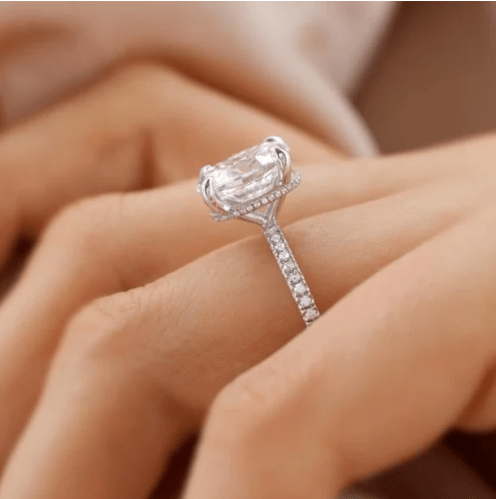
The hidden halo is often described as subtle, but that description barely captures the sophistication behind its design. Beneath its quiet presence lies a level of craftsmanship, proportion and technical precision that distinguishes it from more overt engagement ring features. Its beauty is not accidental. It is engineered.
At a time when engagement ring design has shifted away from excess and towards considered refinement, the hidden halo has emerged as a benchmark of modern elegance. It reflects a growing appreciation for details that reward close attention rather than immediate recognition, and for craftsmanship that prioritises balance over display.
From a design perspective, the hidden halo is deceptively complex. It requires careful calculation of height, spacing and proportion to ensure that the small diamonds set beneath the centre stone enhance rather than overwhelm the overall form. Unlike visible halos, which dominate the ring’s appearance, the hidden halo must integrate seamlessly into the structure.
Jewellery design analysis in Vogue UK has frequently highlighted how modern luxury pieces succeed when they incorporate detail without disrupting silhouette. The hidden halo embodies this principle. From the top view, the ring may appear classic or minimalist. From the side, it reveals depth, texture and refinement.
One of the defining design strengths of the hidden halo is how it enhances the centre stone without altering its perceived shape. Because the halo is placed beneath rather than around the stone, it preserves the clean outline of solitaires and other traditional settings. This makes it ideal for buyers who want a classic look with a modern twist.
This restraint is particularly important in contemporary engagement ring design. As tastes move away from overt sparkle and towards architectural clarity, designers are challenged to add interest without visual clutter. The hidden halo offers a solution that feels both innovative and respectful of tradition.
Craftsmanship plays a central role in achieving this balance. Because the hidden halo is not immediately visible, its execution must be flawless. Stones must be precisely matched, evenly set and perfectly aligned. Any inconsistency becomes noticeable upon closer inspection.
Design commentators writing for Financial Times – How To Spend It have noted that true luxury often reveals itself through elements that are not immediately obvious. The hidden halo fits squarely within this definition. It is a detail chosen by those who value construction as much as appearance.
The technical challenge of setting a hidden halo should not be underestimated. The gallery beneath the centre stone must be strong enough to support the setting while remaining delicate enough to maintain visual lightness. This requires expert metalwork and a deep understanding of structural integrity.
Modern jewellers often combine traditional craftsmanship with advanced design techniques to achieve this precision. The result is a ring that feels both refined and robust, capable of everyday wear without sacrificing elegance.
Brands known for contemporary engagement ring design have embraced the hidden halo precisely because it allows them to showcase craftsmanship discreetly. Jewellers such as Lily Arkwright often use hidden halos to add depth and refinement to their designs while maintaining clean, modern proportions.
Another design advantage of the hidden halo is its adaptability across stone shapes. Whether paired with round, oval, pear or emerald-cut stones, the hidden halo enhances dimension without dictating style. This versatility makes it particularly appealing in a market that values personalisation.
UK buyers, in particular, tend to favour designs that feel timeless rather than trend-bound. The hidden halo supports this preference by complementing a wide range of aesthetics without anchoring the ring to a specific era.
The interaction between metal and stone is also crucial to the hidden halo’s beauty. Yellow gold, white gold and platinum each influence how the hidden halo is perceived. In warmer metals, the halo adds contrast and depth. In cooler metals, it contributes to architectural clarity.
Design features in Harper’s Bazaar UK have highlighted how modern engagement rings increasingly rely on metalwork as much as gemstones to create visual interest. The hidden halo leverages this relationship beautifully, using metal structure to frame light rather than dominate it.
Light behaviour is another key consideration. Because the hidden halo sits beneath the centre stone, it interacts with light differently from surface-level settings. As the ring moves, the small diamonds catch light subtly, creating a gentle glow rather than overt sparkle.
This understated luminosity enhances the centre stone without competing with it. The eye is drawn first to the main diamond, then rewarded with additional depth upon closer inspection. This layered visual experience is a hallmark of sophisticated design.
The hidden halo also aligns well with the rise of lab-grown diamonds. Buyers who choose lab-grown stones often prioritise design integrity and proportion over maximum size. The hidden halo allows designers to add refinement and complexity without increasing surface sparkle or cost.
Jewellers such as Lily Arkwright frequently pair hidden halos with lab-grown centre stones to create engagement rings that feel contemporary, ethical and design-led. The emphasis remains on craftsmanship rather than excess.
From a construction standpoint, the hidden halo can also improve balance and stability. By reinforcing the gallery beneath the centre stone, it can contribute to a lower, more secure setting. This makes the ring more practical for everyday wear, a key consideration for many UK buyers.
Lifestyle coverage in The Telegraph has explored how engagement ring buyers increasingly consider wearability alongside aesthetics. The hidden halo responds directly to this concern, offering added detail without increasing vulnerability.
Another reason designers favour the hidden halo is its ability to add complexity without compromising comfort. Because the halo is tucked beneath the stone, it does not rub against adjacent fingers or catch on clothing. This thoughtful placement reflects a user-centred design philosophy.
This focus on the wearer rather than the observer is a defining characteristic of modern jewellery design. Engagement rings are no longer static symbols. They are functional objects worn daily. The hidden halo supports this evolution by prioritising comfort and longevity.
Design historians writing for The Victoria and Albert Museum have noted that jewellery designs most likely to endure are those that integrate detail into structure rather than applying it superficially. The hidden halo aligns perfectly with this principle.
From a long-term perspective, this integration matters. Engagement rings are rarely replaced. They must age gracefully alongside the wearer. The hidden halo’s subtlety ensures that it continues to feel relevant even as tastes evolve.
Importantly, the hidden halo does not demand explanation. It can be appreciated instinctively, discovered gradually and enjoyed privately. This quiet confidence is central to its design appeal.
For couples seeking an engagement ring that reflects modern values without abandoning tradition, the hidden halo offers an ideal compromise. It allows for expression without excess, complexity without clutter and craftsmanship without showmanship.
In an era where design literacy among consumers is higher than ever, details like the hidden halo resonate strongly. Buyers recognise and appreciate thoughtful construction, even when it is not immediately visible.
Ultimately, the beauty of the hidden halo lies in its understanding of modern design priorities. It respects proportion, honours craftsmanship and rewards attention. It is not a feature that competes for notice, but one that enriches the whole.
As engagement ring design continues to evolve, the hidden halo stands as an example of how subtle innovation can create lasting appeal. It proves that the most compelling details are often the ones that do not ask to be seen — but are unmistakable once discovered.
 Diamonds are a girls best friend
Leave a comment