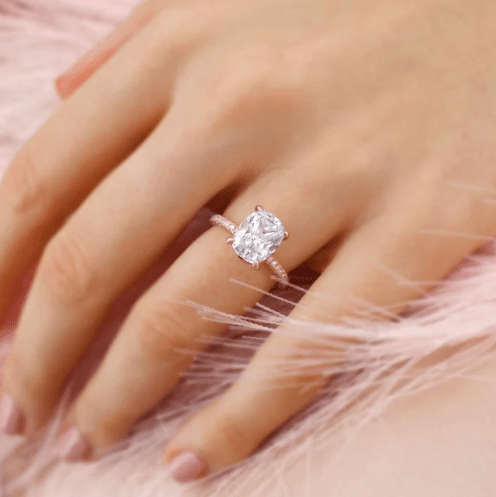
Buying an engagement ring is often treated as a once in a lifetime creative moment. Couples are encouraged to personalise, customise and push design boundaries in the name of individuality. Yet many of the most common regrets in the engagement ring market have nothing to do with taste and everything to do with structure. In 2026, buyers are increasingly realising that an engagement ring is not just an aesthetic object but a piece of wearable engineering that must perform every single day.
Bespoke design can be incredibly rewarding when done well, but without an understanding of durability, proportion and wear patterns, it can also introduce weaknesses that only become apparent months or years later. Knowing which design features to avoid is not about playing it safe. It is about ensuring that creativity is supported by longevity.
One of the most widespread mistakes is choosing a band that is simply too thin for everyday wear. Ultra-delicate bands have dominated social media imagery for years, but they are rarely designed with long-term structural integrity in mind. Technical guidance from the Gemological Institute of America explains that thin bands are far more susceptible to bending, twisting and permanent distortion, especially when paired with a centre stone of noticeable size.
Bands under approximately 1.8mm may feel refined initially, but daily pressure from gripping objects, resting hands on surfaces or even minor knocks can gradually alter the ring’s shape. Once a band begins to oval, the setting is placed under uneven tension, increasing the risk of prong movement and stone loosening. Over time, repeated repairs only weaken the metal further.
High-set engagement rings are another design choice that frequently leads to regret. While elevated centre stones can look striking, they introduce practical issues that are often underestimated. Consumer research discussed by Which? highlights snagging as one of the most common complaints among ring wearers. The higher the stone sits, the more likely it is to catch on clothing, hair and everyday surfaces.
Beyond inconvenience, high settings increase impact risk. A stone positioned further from the finger absorbs more force when knocked. Over time, this repeated stress transfers directly to the prongs. Even well-made prongs can weaken under constant impact, eventually compromising stone security.
Fancy-shaped diamonds present their own challenges when not correctly protected. Shapes such as pear, marquise and heart cuts feature pointed tips that are structurally vulnerable. Leaving these points exposed for aesthetic reasons is a common bespoke error. Research from the American Gem Society confirms that exposed points are significantly more prone to chipping than rounded edges.
Protective V-prongs or full bezel settings are essential for these shapes. Without them, even light contact with hard surfaces can cause damage. Chips may begin invisibly but can spread over time, permanently affecting the stone’s appearance and integrity.
Hidden halos are another feature that often underperforms when poorly executed. In theory, a hidden halo or support rail can strengthen prongs and add stability. In practice, many bespoke designs position the halo too low to offer any real reinforcement. Structural explanations from the Gemological Institute of America show that support must sit at the prong junction to be effective.
When a hidden halo is placed beneath this critical point, it becomes purely decorative. The prongs remain unsupported where stress is highest, increasing the likelihood of loosening over time. This can be particularly misleading, as buyers often believe the halo adds security when it does not.
Pavé detailing is another area where enthusiasm frequently outweighs practicality. Rings covered in small pavé stones can appear intricate and luxurious, but small stones are inherently more vulnerable to loss. Reporting by The Guardian on jewellery wear has noted that pavé settings account for a disproportionate number of repair requests due to stone loss.
When pavé stones are set too shallowly or with minimal metal, everyday wear can loosen them. Replacing lost stones repeatedly can weaken the band itself, particularly if metal has already been reduced to achieve a delicate look.
Flush-fit compatibility is another detail often overlooked in bespoke engagement ring design. Rings that prevent a wedding band from sitting flush may look distinctive on their own, but they often create long-term discomfort. Gaps between rings trap debris, wear unevenly and can feel awkward when worn together.
Guidance from the National Association of Jewellers suggests that flush-fit designs generally offer better comfort and longevity. Non-flush designs frequently require custom wedding bands later, adding cost and complexity that buyers did not anticipate.
Material selection is equally critical. Some gemstones are simply not suitable for daily wear. Opal, moonstone and pearl all have relatively low hardness ratings and are highly sensitive to impact, moisture and temperature changes. Educational material from the Gemological Institute of America makes clear that these stones are best reserved for occasional jewellery rather than engagement rings.
Despite this, bespoke designs sometimes prioritise uniqueness over practicality. Over time, these softer stones are prone to scratching, cracking or surface deterioration, leading to disappointment and costly replacements.
Metal choice can also introduce problems. While gold is a popular option, very thin or soft alloy compositions wear down faster. Research from the World Gold Council explains how metal density and alloy choice directly affect durability. Lightweight bands may feel comfortable initially but can thin further with wear, particularly along the base of the ring.
Protruding or sharp design elements are another frequent issue. Intricate or sculptural designs with exposed edges often snag on clothing and scratch surfaces. Consumer behaviour analysis from the Financial Times shows that physical inconvenience is one of the fastest ways for a luxury item to lose its appeal, even if it was initially loved.
Prong design itself is often underestimated. Bulky, uneven or poorly finished prongs not only look unrefined but also increase snagging and dirt accumulation. Precision finishing ensures prongs are smooth, proportionate and secure, enhancing both comfort and longevity.
Halo designs can also suffer from poor execution. When a halo does not sit tightly against the centre stone, visible gaps appear. These gaps trap debris and visually reduce the size and brilliance of the centre stone. Technical guidance from the Gemological Institute of America stresses the importance of tight tolerances in halo construction.
Many of these issues arise when bespoke design prioritises novelty over wearability. True custom design should enhance performance, not undermine it. The most successful bespoke rings are those where creativity is guided by an understanding of how jewellery behaves over time.
Jewellers who specialise in engagement rings designed for daily wear increasingly steer clients away from fragile design choices. Brands such as Lily Arkwright focus on proportion, setting security and material performance alongside aesthetics, helping buyers avoid regrets before they happen.
In 2026, engagement ring buyers are becoming more informed and more realistic. A ring is no longer judged solely on how it looks in a proposal photo, but on how it feels years later.
Avoiding these common design mistakes does not mean sacrificing individuality. It means choosing a ring that balances expression with endurance, artistry with engineering and beauty with practicality.
An engagement ring should support a lifetime of wear, not require constant repair. When bespoke design is approached with both creativity and structural intelligence, the result is a ring that remains meaningful, secure and beautiful long after the moment it is given.


Leave a Reply