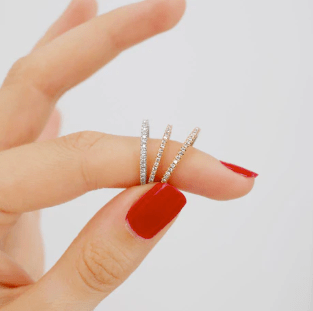
The wedding ring is one of the most enduring objects in human history. It is small, unassuming and worn so consistently that it often fades into the background of daily life. Yet few objects carry as much symbolic weight. Across centuries, cultures and belief systems, the wedding ring has represented union, obligation, devotion and identity. Its history is not static. It evolves alongside society itself, reflecting how marriage has been understood in different eras.
The earliest known wedding rings originate in Ancient Egypt, where marriage was closely tied to ideas of eternity and cosmic order. Rings were crafted from natural materials such as reeds, rushes or leather and exchanged as symbols rather than valuables. The circle was sacred, representing infinity and the cyclical nature of life.
Historical research referenced by the British Museum explains that Egyptians viewed marriage as part of a broader spiritual framework. The ring’s unbroken shape symbolised continuity not just between two individuals, but within the universe itself. These early wedding rings were worn publicly, acting as visible markers of status and union.
It was during this period that the tradition of wearing a ring on the fourth finger of the left hand emerged. The belief that this finger contained a vein leading directly to the heart, known later as the vena amoris, was symbolic rather than anatomical. Despite its inaccuracy, the idea endured and shaped wedding customs for centuries.
The Roman Empire adopted the practice of wedding rings but redefined their meaning. Roman marriage was rooted in law and property, and rings reflected this reality. Early Roman wedding rings were made of iron, chosen for its strength and durability. They signified permanence, but also control and ownership.
Over time, gold rings became more common among affluent Romans, signalling wealth as well as marital status. According to collections and commentary from the Metropolitan Museum of Art, Roman rings functioned as legal markers. They were worn almost exclusively by women, reinforcing the gendered structure of marriage at the time.
As Christianity spread throughout Europe, wedding rings were absorbed into religious ritual. By the early Middle Ages, rings were formally exchanged during church ceremonies and blessed by clergy. Marriage was reframed as a sacred covenant rather than a civil arrangement.
Liturgical texts and manuscripts referenced by the Vatican Library show that rings became symbols of fidelity, obedience and divine unity. The act of placing a ring on the finger was ritualised and accompanied by vows, prayers and blessings.
During this period, wedding rings also began to carry more decorative and personal elements. Engravings became common, and the emergence of posy rings marked a shift towards emotional expression. These rings were engraved with short phrases, verses or declarations of love, often hidden inside the band.
Scholars at the British Library have documented how posy rings reflected changing attitudes towards marriage in late medieval England. Love and affection were becoming recognised as meaningful components of marriage, not merely secondary to alliance or duty.
The Renaissance brought further refinement. Advances in metallurgy and craftsmanship allowed goldsmiths to produce more consistent, elegant bands. Rings became slimmer, smoother and more comfortable to wear. Gemstones began to appear more frequently, chosen for their symbolic meanings rather than brilliance.
Sapphires were associated with loyalty, rubies with passion and emeralds with renewal. Diamonds were admired but still rare and difficult to cut. Their later dominance in bridal jewellery had not yet begun.
From the seventeenth to nineteenth centuries, wedding rings increasingly reflected social hierarchy. Among aristocratic families, rings featured heraldic engravings, coats of arms or elaborate designs. Marriage was as much about lineage and inheritance as personal connection.
The Industrial Revolution transformed wedding rings more profoundly than any earlier period. Mass production made jewellery accessible to a broader population, and gold wedding bands became common across social classes. Rings no longer signified privilege alone, but participation in a shared cultural ritual.
Victorian wedding rings reflected the era’s emphasis on sentiment, morality and domestic ideals. Designs often incorporated hearts, flowers or symbolic motifs. According to design historians at the Victoria and Albert Museum, Victorian jewellery marked a shift towards emotional symbolism, reinforcing the idea of marriage as a bond of affection.
The twentieth century reshaped the meaning of wedding rings once again. During the First World War, men began wearing wedding rings in significant numbers for the first time. Soldiers carried them as reminders of home, stability and emotional connection.
Social historians writing for the Imperial War Museums note that this practice permanently altered marriage symbolism. The wedding ring became a shared emblem of partnership rather than a marker worn solely by women.
In the decades that followed, the plain gold band became the dominant style in many Western cultures. Simplicity was associated with sincerity and permanence. The wedding ring was no longer decorative, but deeply functional and symbolic.
By the late twentieth century, this uniformity began to dissolve. Changing fashion, evolving gender roles and greater emphasis on individuality reshaped expectations. White metals gained popularity, comfort-focused designs emerged and couples began choosing rings that reflected lifestyle as much as tradition.
Contemporary wedding rings are defined by choice. Matching bands are optional. Traditional profiles sit alongside modern interpretations. Rings are selected for comfort, symbolism and personal meaning rather than adherence to a single ideal.
Sociological analysis from the Pew Research Center highlights how modern relationships prioritise equality and self-expression. Wedding rings have adapted accordingly, becoming reflections of shared values rather than prescribed forms.
Cultural commentary in Vogue has observed that modern wedding jewellery balances heritage with individuality. Couples honour tradition while reshaping it to fit their own narrative.
Exploring a wide range of wedding rings today means engaging with a tradition that spans thousands of years while still feeling entirely personal. Each ring carries echoes of history, even as it marks a unique commitment.
Despite centuries of change, certain elements remain constant. The circular shape endures. The act of exchange remains powerful. The ring continues to serve as a visible promise worn every day.
Looking ahead, wedding rings will continue to evolve as marriage itself evolves. As cultural norms expand and relationships are defined in more inclusive ways, rings will adapt in form, material and meaning.
What will not change is the human desire to mark commitment with something tangible. The wedding ring remains a bridge between past and future, tradition and individuality.
A simple band, shaped by history, worn with intention.
 Diamonds are a girls best friend
Leave a comment