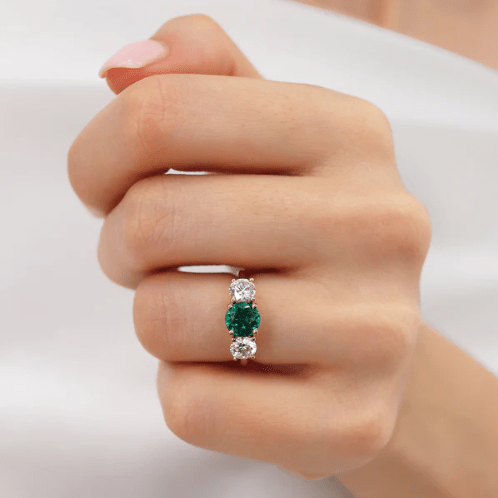
For much of modern history, the diamond engagement ring has functioned as a cultural shorthand. It signalled commitment, financial seriousness and conformity to a widely accepted romantic script. In the UK, this script was never as rigid as in some markets, but the association between engagement and diamonds was nonetheless strong. Today, that association is being quietly re-examined, not through rejection, but through cultural redefinition.
Search trends provide an unusually honest window into this change. Unlike sales data, which reflects final decisions, or editorial coverage, which often shapes aspiration, search behaviour captures uncertainty. It shows what people question before they commit. In the UK, those questions increasingly suggest that engagement rings are becoming less diamond-centred in meaning, even when diamonds remain physically present.
This shift is particularly visible among younger generations. Millennials and Gen Z approach engagement with different assumptions from those of their parents. Many have lived together for years before proposing. Marriage itself is often viewed as a personal milestone rather than a social obligation. Within this context, the engagement ring becomes less about signalling compliance with tradition and more about expressing shared values.
Reporting by The Independent has explored how younger UK couples are redefining relationship milestones, favouring intentionality over inherited expectation. Engagement rings, as visible symbols of commitment, are naturally drawn into this redefinition. When the meaning shifts, the materials and designs that express it are reassessed.
Search queries increasingly reflect this cultural questioning. Phrases such as “do engagement rings have to be diamonds” and “non-traditional engagement ring UK” appear with growing frequency. These are not transactional searches. They are philosophical ones. They indicate a desire for permission to choose differently rather than a simple hunt for alternatives.
Diamonds themselves are not disappearing from these conversations, but they are no longer treated as inevitable. Instead, they are increasingly framed as one option among many. This reframing aligns with broader cultural movements in the UK that challenge singular narratives around success, romance and consumption.
Symbolism plays a crucial role here. For previous generations, diamonds were powerful symbols of permanence and sacrifice. Their cost and rarity reinforced their emotional weight. For many modern buyers, those same qualities are interpreted differently. Permanence is now associated with emotional compatibility rather than material durability. Sacrifice is less celebrated than balance.
Coverage in BBC Culture has examined how symbols evolve as societies change, noting that objects once associated with status can take on new meanings as values shift. In the context of engagement rings, diamonds are increasingly seen as traditional symbols rather than definitive ones.
Ethical awareness has accelerated this symbolic evolution. UK consumers are more informed than ever about global supply chains, environmental impact and labour practices. Investigative journalism by The Guardian has played a significant role in this awareness, particularly around extractive industries. As a result, the diamond’s symbolic purity has become more complex.
This does not mean that diamonds are viewed negatively across the board. Instead, their symbolism has become conditional. Buyers want to know not just what a diamond represents, but how it came to exist. Search behaviour reflects this nuance. Queries increasingly pair diamonds with qualifiers such as “ethical,” “conflict free” or “recycled.”
At the same time, alternatives benefit from symbolic flexibility. Coloured gemstones, lab-grown diamonds and antique rings are not burdened with the same historical narratives. They are free to acquire meaning from the couple rather than from cultural inheritance. For many UK buyers, this openness is appealing.
Search trends around coloured gemstones often include emotional language. Queries like “sapphire engagement ring meaning” or “emerald engagement ring symbolism” suggest that buyers are actively constructing new narratives. Rather than inheriting meaning, they are assigning it.
Editorial features in Vogue UK have increasingly framed engagement rings as personal storytelling devices rather than fixed symbols. This editorial framing influences how consumers think before they buy. When the ring is positioned as an expression of identity, stone choice becomes less prescriptive.
Royal and celebrity influence has also evolved. While royal engagement rings once reinforced diamond norms, recent coverage has broadened acceptable imagery. The enduring popularity of sapphire engagement rings, often traced back to Princess Diana, has become less about royalty and more about individuality. This evolution has been explored in depth by Town & Country.
Importantly, the modern appeal of sapphires and other coloured stones is no longer dependent on high-profile endorsement. Search data suggests that interest is sustained even in the absence of media spikes. This indicates that alternatives have become normalised rather than novelty-driven.
Generational attitudes towards ownership also influence this trend. Younger UK consumers are less likely to equate cost with commitment. They are more comfortable decoupling emotional significance from price tags. Analysis in The Financial Times has highlighted how younger buyers prioritise experiences and values over conspicuous consumption. Engagement rings are increasingly subject to the same logic.
This shift is visible in how buyers search for rings that “fit” their lives rather than impress others. Queries related to durability, maintenance and comfort appear frequently alongside stone type. Diamonds, while durable, are not automatically perceived as the most practical option depending on cut and setting. This opens the door to alternatives perceived as better suited to daily wear.
The growing popularity of lab-grown diamonds sits at the intersection of tradition and redefinition. Chemically identical to mined diamonds, they allow buyers to retain familiar symbolism while rejecting certain aspects of the diamond industry. Search queries often frame lab-grown diamonds as “modern” or “ethical,” signalling symbolic renewal rather than abandonment.
Coverage by BBC Future has discussed how lab-grown diamonds disrupt traditional narratives of rarity and value. In the UK context, this disruption appears to be welcomed by buyers who prioritise intention over convention. The diamond’s symbolism shifts from scarcity to choice.
Antique and vintage engagement rings represent another symbolic pathway away from diamond centrality. These rings often feature old-cut diamonds or coloured stones, but their appeal lies in history rather than hierarchy. Searches related to “antique engagement ring UK” often emphasise story, sustainability and uniqueness.
Features in Country Life have highlighted how antique jewellery appeals to UK buyers seeking continuity rather than novelty. In this context, the stone itself becomes secondary to provenance and narrative. The engagement ring is valued as an object with a past, not just a promise of the future.
Language analysis further supports this cultural shift. UK search queries increasingly use the word “alternative” not as a compromise, but as a preference. The term has shed its implication of second-best. Instead, it signals deliberate deviation from norms.
This linguistic change matters. When alternatives are framed positively, they gain legitimacy. Diamonds no longer need to be rejected for alternatives to be chosen. They simply need to share space.
Retail experiences reflect this evolution. UK jewellers report that customers are more open to discussion and comparison. Diamonds may still be chosen in the end, but the process feels more exploratory. Trade coverage in Jewellery Focus has noted that consumers increasingly expect education rather than persuasion.
Social media reinforces this pluralism. While platforms once amplified diamond-centric imagery, they now showcase a wide spectrum of engagement rings. UK consumers encounter coloured stones, mixed metals and unconventional designs daily, reducing the psychological barrier to choosing differently.
Importantly, this shift does not appear to diminish the emotional significance of engagement rings. If anything, it intensifies it. When couples actively choose what their ring represents, rather than inheriting meaning, attachment often deepens.
Psychologists writing for Psychology Today have noted that meaning constructed through choice tends to feel more personal and enduring than meaning inherited through tradition. Engagement rings chosen through intentional exploration may therefore carry greater emotional weight, regardless of stone type.
In this context, the question is not whether engagement rings are becoming less diamond-focused, but how focus is defined. Diamonds remain present, but they are no longer the sole carriers of meaning. They coexist with alternatives that reflect evolving values around ethics, individuality and authenticity.
UK search trends suggest that engagement rings are moving away from obligation and towards expression. The diamond’s role is changing from default to deliberate. For many couples, this is not a loss, but a liberation.
As cultural attitudes continue to evolve, this diversification is likely to deepen. Engagement rings will increasingly reflect the diversity of relationships themselves. The data does not point to the end of diamonds, but to the end of their unquestioned dominance.
In the UK, where understatement and personal meaning have long held cultural currency, this evolution feels less like a revolution and more like a return to choice.
 Diamonds are a girls best friend
Leave a comment