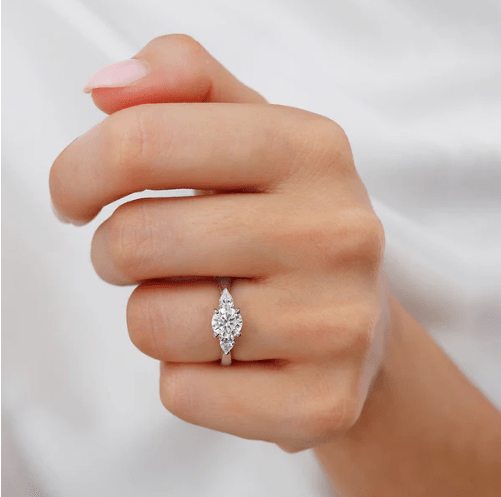
The trilogy engagement ring has always held a certain quiet power in British jewellery culture. It is neither ostentatious nor overly traditional, yet it carries more symbolism than almost any other design. Three stones set side by side can communicate emotion, memory and hope in a way that a single gem cannot. The trilogy ring has existed for centuries in various forms, but in 2026, it has re emerged as one of the most meaningful choices for modern British couples. The ring that once whispered its symbolism now speaks clearly to a generation seeking deeper significance in their jewellery.
Across the UK, jewellers, designers and historians have noted a marked return to the emotional architecture of the trilogy ring. As Vogue UK observed in a recent feature on the resurgence of symbolic jewellery, British couples are gravitating towards designs that feel personal and expressive. The trilogy ring, with its narrative structure and sculptural balance, fits perfectly within this shift.
This article explores the long history of trilogy engagement rings in Britain, from their early European origins to their Victorian and Edwardian interpretations, followed by their Art Deco transformation and their twenty first century revival. It also examines how the trilogy ring has adapted to modern tastes while retaining its timeless symbolism of past, present and future.
Early Origins: The Storytelling Power of Three
The idea of three stones aligned together predates the engagement ring as we know it today. In many ancient cultures, the number three held deep symbolic meaning. It appears in mythologies, religious texts, folklore and literature, often representing harmony, unity and the natural cycles of life.
In classical Europe, triad jewellery was associated with protection and spiritual balance. Pieces incorporating three gems or motifs were believed to guard the wearer or bring emotional grounding. Although these early designs were not specifically engagement rings, they set the stage for the trilogy ring’s later symbolism.
By the eighteenth century, three stone rings were gaining popularity in aristocratic circles. These rings were often designed with coloured gemstones rather than diamonds, reflecting the tastes of the era. Sapphires, emeralds, rubies and garnets were common choices, arranged in elegant cluster or collet settings. Diamonds were still rare and prized mainly for their brilliance rather than their symbolic value.
Even then, early trilogy rings hinted at what they would eventually become: wearable narratives, telling stories through composition rather than inscription.
Victorian Britain and the Power of Sentiment
The Victorian era introduced a new understanding of romance and symbolism, and engagement rings became more emotionally expressive than ever before. Queen Victoria herself played an influential role in shaping jewellery trends. Her own enthusiasm for meaningful motifs such as hearts, serpents, flowers and engraved messages helped popularise sentimental jewellery throughout the country.
It was during this period that the trilogy ring truly began to flourish. Victorians assigned emotional meaning to almost every gemstone and arrangement, and a ring featuring three stones quickly came to represent a couple’s past, present and future. That simple but profound meaning resonated across classes, and trilogy rings became one of the most recognisable expressions of Victorian romantic imagination.
The BBC’s Culture section often highlights how Victorian design linked narrative and ornamentation, and trilogy rings fit seamlessly into this aesthetic world. Rings typically combined coloured gemstones with small diamonds, or used three graduated stones to create visual rhythm. The designs could be delicate or bold depending on the wearer’s taste, but the core symbolism remained the same.
Victorian trilogy rings were also frequently given not only at engagements but at anniversaries and significant milestones. Jewellery historians note that this versatility made them one of the century’s most enduring motifs.
Edwardian and Art Deco Interpretations: Three Stones Meet Modernity
When the Edwardian era began in the early twentieth century, jewellery design shifted towards lightness and elegance. Platinum became the metal of choice, allowing jewellers to create intricate filigree settings. Trilogy rings from this era often featured three diamonds of matching size, set in airy mountings that emphasised luminosity and refinement.
However, it was the Art Deco era that truly reshaped the trilogy ring into the form most recognisable today. The aesthetic of the 1920s and 1930s embraced symmetry, geometry and a fascination with modern materials. Trilogy rings grew bolder, more architectural and more visually striking.
Where Edwardian trilogy rings were delicate, Art Deco versions had sharp angles, contrasting gemstones and crisp structural balance. Trilons or tapered baguettes sometimes replaced the side stones, adding sleek lines and distinctive silhouettes that reflected the cultural modernity of the 1920s.
In a feature on twentieth century jewellery, The Guardian discussed how the Art Deco movement transformed engagement ring design, moving away from purely romantic motifs towards designs that reflected confidence and modernity. Trilogy rings from this era mirrored that shift, combining symbolism with bold aesthetics.
Hollywood’s Influence and the Trilogy Ring’s Mid Century Appeal
By the mid twentieth century, the trilogy ring had entered the sphere of Hollywood glamour. Film stars often wore multi stone rings that set trends across Europe and the United States. Diamonds had become more accessible, and the trilogy ring’s clean structure suited the streamlined fashion of the era.
Although solitaire rings dominated after the 1940s due to aggressive diamond marketing, trilogy rings never disappeared. They maintained a loyal following among brides who preferred something symbolic and subtly individual.
The Financial Times noted in a retrospective on engagement ring marketing that multi stone rings provided an alternative narrative for women who saw jewellery as a form of personal expression rather than merely a status symbol. Trilogy rings, with their narrative dimension, appealed particularly to modern, self assured women of the mid century.
The Modern Revival: Why UK Couples Are Choosing Trilogy Rings Again
In 2026, the trilogy ring is enjoying a remarkable resurgence. Modern British couples are drawn to its story driven symbolism, but also to its adaptability. Trilogy rings today can be classic or contemporary, understated or dramatic, depending on the choice of stones, settings and proportions.
According to Cosmopolitan UK, the rise of personalised engagement jewellery has created renewed interest in rings that carry deeper meaning. Trilogy rings fit naturally into that shift, as wearers can customise each stone to reflect a personal message. Some choose three diamonds of equal size for balance, while others prefer a central stone accented with two coloured gems for contrast. The meaning remains intact regardless of aesthetic.
Social media has also played a role in the trilogy ring’s revival. Platforms such as Pinterest and Instagram have become visual mood boards for engagement ring inspiration, and three stone rings consistently attract high engagement. Their symmetry is appealing to the eye, and their symbolism resonates with couples who value emotional storytelling.
As BBC News Lifestyle noted in a recent feature on jewellery trends, younger generations are placing increasing emphasis on the emotional meaning of their purchases. Trilogy rings encapsulate that trend beautifully.
Symbolism in the Twenty First Century: A Ring That Holds Space for the Past and the Future
While the trilogy ring’s symbolism of past, present and future remains its most commonly cited meaning, modern interpretations have expanded. Some couples see the centre stone as representing their relationship, while the two supporting gems signify individual identities brought together in partnership. Others view the three stones as symbols of friendship, love and fidelity.
The New York Times has written about the growing demand for jewellery with personal resonance, noting that many modern consumers choose pieces that reflect their worldview rather than tradition alone. Trilogy rings align perfectly with this trend because they are inherently narrative. Every wearer assigns their own meaning to the three stones, and no two interpretations are ever the same.
This flexibility explains why trilogy rings remain relevant across generations. They carry history, but they also invite reinvention.
The Future of Trilogy Rings in the UK: New Materials, New Stories
As the jewellery world becomes more innovative, trilogy rings are evolving in style and substance. Lab grown diamonds have transformed the market, making larger stones more accessible without compromising quality or ethics. Coloured gemstones are also reappearing in trilogy designs, echoing the Victorian era while aligning with modern sustainability values.
Designers are experimenting with proportions, mixing shapes, incorporating asymmetry and using unexpected colour combinations. The trilogy ring is no longer limited to three matching stones. Instead, it has become a canvas for creativity.
According to Vogue UK, this willingness to personalise engagement jewellery is one of the defining trends of the decade. Trilogy rings, with their built in capacity for storytelling, offer endless possibilities for customisation.
Conclusion: A Ring That Carries History Into the Present
The trilogy engagement ring is one of the rare designs that feels both ancient and contemporary. It has travelled through centuries of European romance, Victorian sentimentality, Edwardian elegance and Art Deco modernity. It has adorned royalty, film stars and everyday couples who wanted a ring that spoke to more than a single moment in time.
In 2026, the trilogy ring stands at the intersection of tradition and innovation. It honours the past, embraces the present and gestures toward the future. British couples, drawn to its symbolism and its sculptural beauty, are rediscovering what makes this design so enduring.
It is more than a ring. It is a story told in three parts, held together by love, memory and hope. A trilogy engagement ring captures the essence of a shared journey, reminding wearers that their story is not just about where they are going, but where they have been and what they are building together.
 Diamonds are a girls best friend
Leave a comment