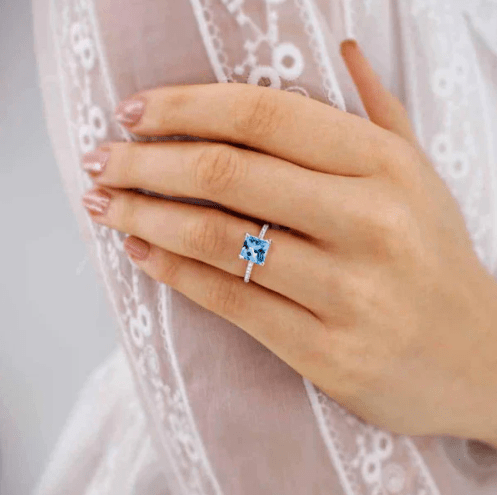
Aqua spinel has never relied on spectacle to justify its place in fine jewellery. Its appeal has always been quieter, shaped by clarity, stability and a colour that suggests calm rather than command. For much of history, aqua spinel existed in the shadow of better-known gemstones, valued but misunderstood, admired but misnamed. Its journey from geological curiosity to deliberate modern choice mirrors the broader evolution of gemmology itself.
Spinel is a naturally occurring mineral composed of magnesium aluminium oxide. It forms under extreme heat and pressure in metamorphic environments, often alongside corundum and other prized gemstones. Aqua spinel refers to spinel crystals displaying pale blue to blue green hues, colours typically produced by trace amounts of iron within the crystal structure.
For centuries, spinel’s physical similarity to other gemstones shaped its fate. Before modern mineral science, gemstones were classified primarily by colour and hardness. Aqua toned spinels were therefore frequently mistaken for sapphires or aquamarines, a confusion that persisted well into the early modern period.
Historical research and collections held by British Museum show how spinel entered royal treasuries and ceremonial objects under assumed identities. These stones were valued for their brilliance and durability, even when their true mineral classification was unknown.
In ancient South Asia, spinel was mined in regions now associated with Afghanistan, Myanmar and Sri Lanka. These stones travelled along established trade routes into the Middle East and Europe, where they were incorporated into jewellery, regalia and religious artefacts.
Scientific research published by Smithsonian National Museum of Natural History explains that spinel’s hardness and resistance to wear made it particularly attractive to early jewellers. Aqua coloured examples were admired for their clarity and soft chromatic presence, qualities that aligned with intellectual and spiritual symbolism.
During the medieval period, colour symbolism played a significant role in how gemstones were understood. Pale blue and blue green stones were associated with balance, composure and clarity of thought. While deeper blue sapphires were linked to divine authority, lighter aqua tones suggested reason and emotional steadiness.
Lapidary texts preserved by British Library describe pale blue gemstones as aids to calm judgement and protection against emotional excess. Aqua spinel, though unnamed as such, fit naturally within this philosophical framework.
The Renaissance marked a gradual shift towards scientific observation. Scholars began to examine gemstones more critically, assessing hardness, crystal form and optical behaviour. Spinel started to emerge as a distinct mineral, though confusion with sapphire persisted for generations.
Jewellery objects examined by Victoria and Albert Museum demonstrate how spinel was widely used during this period, often set alongside diamonds and pearls. Aqua coloured stones were favoured for adding lightness and refinement, particularly in gold rings and pendants.
The eighteenth and nineteenth centuries brought decisive change. Advances in mineralogy and chemistry allowed gemstones to be classified accurately based on composition rather than appearance alone. Spinel was formally recognised as its own mineral species, separate from corundum.
Research documented by Natural History Museum shows how this reclassification revealed spinel’s exceptional stability, lack of cleavage and impressive hardness. These qualities made it not only beautiful, but highly practical for jewellery intended to be worn regularly.
Despite this scientific clarity, aqua spinel remained a connoisseur’s stone. Its colour was subtle rather than dramatic, appealing to those who valued restraint and balance. While emeralds, sapphires and diamonds dominated popular imagination, aqua spinel maintained a quieter presence.
In the early twentieth century, design movements such as Art Deco briefly elevated aqua spinel’s profile. Its cool, translucent tones worked harmoniously with platinum and geometric forms, softening architectural designs without undermining their precision.
Design analysis from Metropolitan Museum of Art shows how pale blue gemstones were used to introduce tonal contrast while preserving symmetry. Aqua spinel’s clarity made it especially effective in these compositions.
The most transformative chapter in aqua spinel’s history arrived with scientific innovation in gemstone creation. Advances in crystal growth technology made it possible to produce spinel in laboratory environments that replicate the conditions of natural formation.
Lab grown spinel is chemically, physically and optically identical to natural spinel. It shares the same crystal structure, hardness and optical properties. The difference lies solely in origin rather than substance.
Educational resources from Gemological Institute of America confirm that lab grown spinel cannot be distinguished from natural spinel without specialised testing. From a performance and durability perspective, the stones are equivalent.
The emergence of lab grown aqua spinel gemstones has reshaped how this gemstone is approached in contemporary jewellery design. Colour consistency, clarity and size can now be achieved with precision, allowing designers to work intentionally rather than adapt to geological variability.
From a design perspective, lab grown aqua spinel aligns closely with modern aesthetics that prioritise harmony and subtle expression. Its tranquil hue complements minimalist jewellery styles where colour carries emotional significance rather than decorative weight.
Cultural commentary in Vogue has highlighted the growing appeal of pale blue gemstones as symbols of calm confidence and individuality. Aqua spinel fits naturally within this movement, offering colour without excess or tradition-bound expectation.
There is also a broader philosophical shift underpinning the acceptance of lab grown gemstones. As consumers become more informed, innovation, transparency and scientific progress increasingly shape perceptions of value and luxury.
Analysis from World Economic Forum explores how technological advancement is expanding the definition of luxury by offering choice rather than diminishing meaning. Lab grown spinel exemplifies this evolution, allowing heritage and innovation to coexist.
Symbolically, aqua spinel represents clarity, balance and thoughtful presence. Whether formed over millions of years within the earth or grown through controlled scientific processes, its meaning remains remarkably consistent.
In contemporary jewellery, aqua spinel is often chosen by those who value distinction without ostentation. Its colour feels calming rather than commanding, refined rather than conventional.
Looking ahead, aqua spinel’s future appears increasingly secure. As colour continues to gain prominence in fine jewellery and lab grown gemstones become more widely understood, aqua spinel occupies a compelling space between history and modernity.
It bridges ancient trade routes and modern laboratories, misidentification and understanding, natural rarity and scientific precision.
From overlooked gemstone to consciously chosen material, aqua spinel has come into its own.
It is defined not by noise, but by nuance.
A gemstone of clarity, restraint and modern relevance, shaped by history and prepared for the future.
 Diamonds are a girls best friend
Leave a comment