Tag: UKtennisbracelets

  • Wedding Rings Through Time: How Culture, Craft and Commitment Shaped the Wedding Band

    Wedding Rings Through Time: How Culture, Craft and Commitment Shaped the Wedding Band

    The wedding ring is one of the most enduring objects in human history. It is small, unassuming and worn so consistently that it often fades into the background of daily life. Yet few objects carry as much symbolic weight. Across centuries, cultures and belief systems, the wedding ring has represented union, obligation, devotion and identity. Its history is not static. It evolves alongside society itself, reflecting how marriage has been understood in different eras.

    The earliest known wedding rings originate in Ancient Egypt, where marriage was closely tied to ideas of eternity and cosmic order. Rings were crafted from natural materials such as reeds, rushes or leather and exchanged as symbols rather than valuables. The circle was sacred, representing infinity and the cyclical nature of life.

    Historical research referenced by the British Museum explains that Egyptians viewed marriage as part of a broader spiritual framework. The ring’s unbroken shape symbolised continuity not just between two individuals, but within the universe itself. These early wedding rings were worn publicly, acting as visible markers of status and union.

    It was during this period that the tradition of wearing a ring on the fourth finger of the left hand emerged. The belief that this finger contained a vein leading directly to the heart, known later as the vena amoris, was symbolic rather than anatomical. Despite its inaccuracy, the idea endured and shaped wedding customs for centuries.

    The Roman Empire adopted the practice of wedding rings but redefined their meaning. Roman marriage was rooted in law and property, and rings reflected this reality. Early Roman wedding rings were made of iron, chosen for its strength and durability. They signified permanence, but also control and ownership.

    Over time, gold rings became more common among affluent Romans, signalling wealth as well as marital status. According to collections and commentary from the Metropolitan Museum of Art, Roman rings functioned as legal markers. They were worn almost exclusively by women, reinforcing the gendered structure of marriage at the time.

    As Christianity spread throughout Europe, wedding rings were absorbed into religious ritual. By the early Middle Ages, rings were formally exchanged during church ceremonies and blessed by clergy. Marriage was reframed as a sacred covenant rather than a civil arrangement.

    Liturgical texts and manuscripts referenced by the Vatican Library show that rings became symbols of fidelity, obedience and divine unity. The act of placing a ring on the finger was ritualised and accompanied by vows, prayers and blessings.

    During this period, wedding rings also began to carry more decorative and personal elements. Engravings became common, and the emergence of posy rings marked a shift towards emotional expression. These rings were engraved with short phrases, verses or declarations of love, often hidden inside the band.

    Scholars at the British Library have documented how posy rings reflected changing attitudes towards marriage in late medieval England. Love and affection were becoming recognised as meaningful components of marriage, not merely secondary to alliance or duty.

    The Renaissance brought further refinement. Advances in metallurgy and craftsmanship allowed goldsmiths to produce more consistent, elegant bands. Rings became slimmer, smoother and more comfortable to wear. Gemstones began to appear more frequently, chosen for their symbolic meanings rather than brilliance.

    Sapphires were associated with loyalty, rubies with passion and emeralds with renewal. Diamonds were admired but still rare and difficult to cut. Their later dominance in bridal jewellery had not yet begun.

    From the seventeenth to nineteenth centuries, wedding rings increasingly reflected social hierarchy. Among aristocratic families, rings featured heraldic engravings, coats of arms or elaborate designs. Marriage was as much about lineage and inheritance as personal connection.

    The Industrial Revolution transformed wedding rings more profoundly than any earlier period. Mass production made jewellery accessible to a broader population, and gold wedding bands became common across social classes. Rings no longer signified privilege alone, but participation in a shared cultural ritual.

    Victorian wedding rings reflected the era’s emphasis on sentiment, morality and domestic ideals. Designs often incorporated hearts, flowers or symbolic motifs. According to design historians at the Victoria and Albert Museum, Victorian jewellery marked a shift towards emotional symbolism, reinforcing the idea of marriage as a bond of affection.

    The twentieth century reshaped the meaning of wedding rings once again. During the First World War, men began wearing wedding rings in significant numbers for the first time. Soldiers carried them as reminders of home, stability and emotional connection.

    Social historians writing for the Imperial War Museums note that this practice permanently altered marriage symbolism. The wedding ring became a shared emblem of partnership rather than a marker worn solely by women.

    In the decades that followed, the plain gold band became the dominant style in many Western cultures. Simplicity was associated with sincerity and permanence. The wedding ring was no longer decorative, but deeply functional and symbolic.

    By the late twentieth century, this uniformity began to dissolve. Changing fashion, evolving gender roles and greater emphasis on individuality reshaped expectations. White metals gained popularity, comfort-focused designs emerged and couples began choosing rings that reflected lifestyle as much as tradition.

    Contemporary wedding rings are defined by choice. Matching bands are optional. Traditional profiles sit alongside modern interpretations. Rings are selected for comfort, symbolism and personal meaning rather than adherence to a single ideal.

    Sociological analysis from the Pew Research Center highlights how modern relationships prioritise equality and self-expression. Wedding rings have adapted accordingly, becoming reflections of shared values rather than prescribed forms.

    Cultural commentary in Vogue has observed that modern wedding jewellery balances heritage with individuality. Couples honour tradition while reshaping it to fit their own narrative.

    Exploring a wide range of wedding rings today means engaging with a tradition that spans thousands of years while still feeling entirely personal. Each ring carries echoes of history, even as it marks a unique commitment.

    Despite centuries of change, certain elements remain constant. The circular shape endures. The act of exchange remains powerful. The ring continues to serve as a visible promise worn every day.

    Looking ahead, wedding rings will continue to evolve as marriage itself evolves. As cultural norms expand and relationships are defined in more inclusive ways, rings will adapt in form, material and meaning.

    What will not change is the human desire to mark commitment with something tangible. The wedding ring remains a bridge between past and future, tradition and individuality.

    A simple band, shaped by history, worn with intention.

  • Diamonds and Step-Inspired Brilliant Diamond Shapes: Where History, Light and Modern Design Meet

    Diamonds and Step-Inspired Brilliant Diamond Shapes: Where History, Light and Modern Design Meet

    Diamond cutting has always been a reflection of how different eras understand beauty. At various points in history, value has been placed on size, on rarity, on symmetry, or on brilliance. Step-inspired brilliant diamond shapes exist because these priorities have never remained fixed. Instead, they have evolved, overlapped and occasionally collided, producing cuts that balance structure with light in ways that feel especially relevant today.

    To appreciate why these shapes resonate in a modern context, it is essential to understand how diamond cuts developed and why step cuts and brilliant cuts were once seen as opposing ideals.

    In the earliest days of diamond cutting, aesthetics were secondary. Medieval cutters worked with rudimentary tools and focused primarily on preserving as much of the rough stone as possible. Point cuts and simple table cuts followed the natural octahedral shape of the crystal. These early diamonds offered little sparkle, but they were prized for their durability and rarity rather than optical performance.

    As cutting techniques advanced through the Renaissance, symmetry became more achievable. Cutters began to understand that flat surfaces and consistent angles could influence how light interacted with a stone. This marked the beginning of intentional design in diamond cutting and laid the foundation for step cuts.

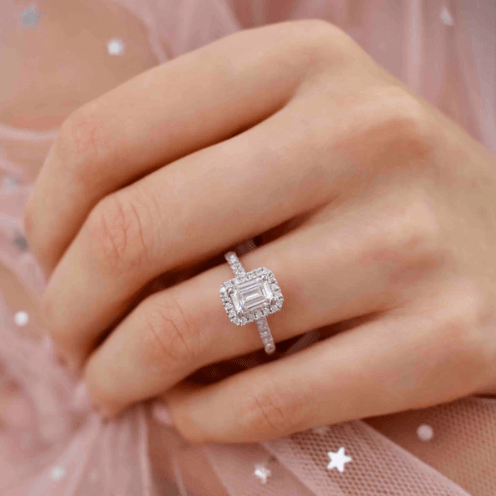
    Step cuts are defined by long, parallel facets arranged in concentric rows. These facets do not aim to scatter light rapidly. Instead, they reflect it in broad, mirror-like flashes that move slowly across the surface. The effect is calm and architectural, drawing the eye into the depth of the stone rather than across its surface.

    Educational material from the Gemological Institute of America explains that step cuts prioritise clarity and colour because their open facets leave little room for visual distraction. Inclusions and tonal nuances are more visible, which historically made these cuts a symbol of confidence and discernment.

    By the eighteenth and nineteenth centuries, step cuts had become closely associated with refinement. Elongated shapes emerged that reflected the architectural tastes of the period, favouring proportion, balance and restraint. The emerald cut became the most recognisable expression of this philosophy, valued for its clean lines and sense of order.

    At the same time, a different approach to beauty was developing. As scientific understanding of optics improved, cutters began experimenting with facet arrangements designed to maximise brilliance. Instead of long parallel planes, brilliant cuts used triangular and kite-shaped facets arranged radially to increase light return.

    This pursuit of sparkle culminated in the refinement of the round brilliant cut in the early twentieth century. Engineered for maximum fire and scintillation, it quickly became the most popular diamond cut in the world. Its energetic light performance contrasted sharply with the measured reflections of step cuts.

    For much of the twentieth century, these two cutting styles were framed as aesthetic opposites. Step cuts were described as elegant, intellectual and understated. Brilliant cuts were described as romantic, emotional and expressive. Buyers were often encouraged to see the choice as a binary one.

    Design history, however, tells a more nuanced story.

    During the Art Deco period, rigid distinctions between structure and sparkle began to soften. Designers embraced geometry, symmetry and modernity, but they also wanted visual impact. Diamonds were cut and set to reflect this duality, combining strong outlines with enhanced brilliance.

    Collections examined by the Victoria and Albert Museum show how Art Deco jewellery frequently blended step-based geometry with complex faceting. This era marked one of the earliest moments where step-inspired brilliant concepts began to emerge, even if the terminology did not yet exist.

    As cutting tools became more precise, these hybrid ideas became easier to realise. Laser technology and computer modelling now allow cutters to control angles and proportions with extraordinary accuracy. This precision is essential when working with elongated facets, where even minor asymmetry becomes visible.

    Insight from the International Gemological Institute highlights how modern cutters can now enhance light performance within structured designs, creating diamonds that offer both depth and movement without sacrificing clarity of form.

    This technical progress has reshaped how step-inspired brilliant shapes are perceived. They are no longer viewed as compromises between two ideals. Instead, they are recognised as deliberate design choices that balance restraint with vitality.

    The renewed interest in step cut diamonds reflects this broader shift in taste. These shapes appeal to buyers who appreciate clarity, proportion and history, but who also expect a diamond to feel alive in everyday wear.

    Cultural commentary in Vogue has observed that contemporary jewellery preferences increasingly favour balance over excess. Pieces that feel refined but not austere, expressive but not overwhelming, are particularly sought after. Step-inspired brilliant cuts sit naturally within this aesthetic.

    Modern lifestyles also play a significant role. Jewellery is no longer reserved for formal occasions. Engagement rings, earrings and bracelets are worn daily, often without being removed. Cuts that feel calm and confident rather than overly dramatic align better with this reality.

    Reporting in The Guardian has explored how modern luxury is increasingly defined by longevity and wearability. Pieces that reveal their beauty gradually tend to form stronger emotional bonds than those designed for instant impact.

    Step-inspired brilliant cuts embody this philosophy. Their light performance is slower and more deliberate, creating depth rather than constant scintillation. This measured sparkle feels reassuring and timeless, particularly for those drawn to understated elegance.

    There is also a psychological element to their appeal. Long, parallel facets create visual order and repetition, which many people find calming. When subtle brilliance is layered into this structure, the result feels balanced rather than chaotic.

    Exhibition commentary from institutions such as the Smithsonian National Museum of Asian Art has explored how symmetry and repetition influence aesthetic response. Step-based geometry engages both intellect and emotion, offering beauty that feels stable and considered.

    Historically, step cuts were often associated with formality and ceremonial jewellery. Their restrained reflections suited evening wear and heirloom pieces. Step-inspired brilliant shapes challenge this association by offering adaptability across contexts.

    Lifestyle coverage in Elle has noted that modern jewellery buyers increasingly seek pieces that transition seamlessly between professional, casual and celebratory settings. Diamonds that feel appropriate in all three are particularly valued.

    Individuality is another driving factor. As buyers move away from universal ideals, they gravitate towards cuts that feel distinctive without being unconventional. Step-inspired brilliant shapes occupy this middle ground.

    They are recognisable, yet less ubiquitous than traditional round brilliants. Choosing them often signals intention and design awareness rather than adherence to tradition.

    Economic analysis in the Financial Times has highlighted how modern luxury markets reward discernment. Consumers increasingly value pieces that demonstrate thoughtfulness and longevity rather than trend-driven appeal.

    The historical lineage of step cuts adds another layer of meaning. Their geometry connects modern diamonds to earlier design movements, creating continuity between past and present. When combined with brilliant faceting, this heritage feels reinterpreted rather than nostalgic.

    From an optical perspective, step-inspired brilliant cuts offer a distinct experience of light. Instead of rapid flashes, light moves in broader planes, creating presence and dimension. This quality appeals to those who prefer refinement over exuberance.

    As diamond cutting continues to evolve, the boundary between step and brilliant will likely continue to blur. New designs will explore how geometry and light can coexist in ever more nuanced ways.

    What remains constant is the appeal of balance.

    Step-inspired brilliant diamond shapes are not about choosing between structure and sparkle. They are about understanding how the two can enhance one another.

    They reflect a future-facing approach to jewellery that values clarity, intention and longevity. Diamonds that reveal their beauty through proportion and precision feel particularly suited to modern life.

    In a world defined by considered choices and personal expression, these shapes offer confidence without noise and elegance without rigidity.

    They do not demand attention. They reward it.

    And that quiet assurance is why step-inspired brilliant diamond shapes continue to resonate, not as a passing trend, but as a thoughtful evolution grounded firmly in history.

  • The History and Lore of the Tennis Bracelet: Why a Simple Design Became a Cultural Classic

    The History and Lore of the Tennis Bracelet: Why a Simple Design Became a Cultural Classic

    Few pieces of jewellery have a story as specific, modern and culturally revealing as the tennis bracelet. Its rise was not orchestrated by heritage houses or centuries of tradition, but shaped by an unscripted moment that altered how fine jewellery was perceived. Today, the tennis bracelet represents effortless luxury and everyday confidence, yet its origins are rooted in a time when diamonds were rarely worn without ceremony.

    Before it acquired its now-familiar name, the tennis bracelet existed as a diamond line bracelet. These bracelets were defined by precision rather than drama, featuring a continuous row of evenly matched stones set closely together. They were admired for their symmetry and craftsmanship, but largely associated with formalwear and special occasions.

    For much of the twentieth century, fine jewellery followed clear rules. Diamonds were worn carefully, often reserved for evenings, events or environments where movement was minimal. The idea of wearing a diamond bracelet during physical activity would have seemed impractical, if not reckless.

    That assumption was challenged in 1987 at the US Open.

    During a televised match, tennis champion Chris Evert noticed that the diamond bracelet she was wearing had unclasped and fallen onto the court. She asked officials to stop play while it was recovered. The pause became a widely reported moment, covered by publications including The New York Times, and it immediately captured public attention.

    What resonated was not just the interruption of a major sporting event, but the symbolism behind it. A woman had worn diamonds while competing at the highest level of professional sport. The bracelet was not decorative in the traditional sense. It was part of her presence, her movement and her identity.

    Almost overnight, the diamond line bracelet became known as the tennis bracelet. The name did not originate from a design studio or marketing campaign. It emerged organically through media repetition and public fascination. That authenticity remains central to its enduring appeal.

    Fashion historians writing for Vogue have described the moment as a cultural shift rather than a trend. Jewellery was no longer something that required protection from real life. It could exist within it.

    The tennis bracelet quickly came to symbolise a new approach to luxury. It was elegant, but not precious in the traditional sense. It could be worn without constant awareness, signalling confidence rather than caution.

    Throughout the late 1980s and 1990s, the tennis bracelet gained momentum as women embraced jewellery that reflected autonomy and ease. Its design allowed it to move fluidly with the body, reinforcing the idea that luxury could be lived in rather than preserved.

    Editorial features in Harper’s Bazaar have noted that the tennis bracelet’s appeal lay in its restraint. It did not announce itself loudly, yet it was unmistakably refined. That balance made it adaptable across generations and styles.

    The bracelet’s simplicity also protected it from rapid trend cycles. While statement jewellery surged and receded, the tennis bracelet remained consistent. Its clean line and repetition of stones created a rhythm that felt timeless rather than fashionable.

    Technical developments supported this evolution. Early line bracelets were often fragile, with basic clasps and limited flexibility. As the tennis bracelet became associated with everyday wear, construction methods improved significantly.

    Industry insight from the Gemological Institute of America has highlighted how advancements in setting techniques and clasp security allowed continuous diamond bracelets to become genuinely wearable. These improvements transformed the tennis bracelet from a formal accessory into a reliable everyday piece.

    By the early 2000s, the tennis bracelet had become a staple rather than a novelty. It was worn across age groups and contexts, from professional environments to casual settings. Its versatility became its defining feature.

    Cultural commentary in The Guardian has explored how modern luxury increasingly values function alongside beauty. Pieces that adapt to daily life tend to endure far longer than those tied to rigid formality. The tennis bracelet exemplifies this shift.

    The symbolism of the tennis bracelet has also broadened. Its uninterrupted line of stones is often interpreted as representing continuity, balance and longevity. Unlike engagement rings, which carry specific romantic meaning, the tennis bracelet offers interpretive freedom.

    This openness has made it a popular choice for self-purchase and personal milestones. It can mark achievement, independence or transition without requiring explanation. That flexibility resonates strongly with contemporary buyers.

    Editorial coverage in Elle has highlighted how modern consumers increasingly gravitate towards jewellery that feels personal rather than ceremonial. The tennis bracelet fits this preference, offering elegance without narrative constraint.

    Styling trends have further reinforced its relevance. As fashion has embraced layering and mixing styles, the tennis bracelet has become a natural anchor. It pairs seamlessly with watches, bangles and cuffs, adapting to both minimal and expressive looks.

    Design commentary in Dezeen has noted that minimalist forms often provide the most enduring foundation for self-expression. The tennis bracelet’s linear design allows it to integrate effortlessly into evolving wardrobes.

    Popular culture continues to support its longevity. Celebrities are frequently photographed wearing tennis bracelets outside formal contexts, reinforcing the idea that diamonds belong in everyday life rather than reserved moments.

    Coverage in Vanity Fair has observed that modern style icons favour jewellery that feels natural rather than performative. The tennis bracelet aligns with this sensibility, offering quiet refinement rather than spectacle.

    Another factor in its endurance is accessibility. While traditionally associated with diamonds, the tennis bracelet design has been interpreted across materials and formats, allowing wider engagement with the form while preserving its essence.

    Economic analysis in the Financial Times has explored how luxury categories that balance aspiration with wearability tend to remain resilient. The tennis bracelet’s adaptability has allowed it to remain relevant across changing economic and cultural landscapes.

    Despite decades of evolution, the tennis bracelet has never strayed far from its original appeal. It is defined by balance. It enhances without overpowering. It moves easily between contexts without losing its identity.

    In a jewellery world often driven by extremes, the tennis bracelet offers reassurance. Its design does not demand attention, yet it rewards close appreciation. That quiet confidence is precisely what has kept it relevant.

    As we look to the future, the tennis bracelet continues to feel aligned with modern values. It represents luxury that moves, beauty that adapts and design that respects real life.

    What began as an accidental moment on a tennis court has become a lasting symbol of how jewellery can evolve alongside culture.

    The tennis bracelet is no longer just a design. It is a philosophy of wearability, continuity and self-assured style.

    And that is why its story continues to resonate.