Celebrity engagement rings have always functioned as more than personal milestones. They are cultural signals, quietly reflecting how society understands love, power, luxury and identity at a particular moment in time. As 2026 approaches, the predicted engagement rings of some of the world’s most talked-about couples suggest that we are entering a distinctly new era. One where meaning, restraint and personal narrative matter far more than traditional displays of excess.
The celebrity couples dominating headlines today are not united by a single aesthetic. Instead, they are connected by cultural relevance, creative credibility and a visible move away from formulaic glamour. The engagement rings likely to emerge from these relationships will not chase uniform trends. They will reinforce the idea that there is no longer one correct way for a ring to look, feel or signify commitment.
Timothée Chalamet and Kylie Jenner
The relationship between Timothée Chalamet and Kylie Jenner sits at a fascinating crossroads of culture. Chalamet represents a new generation of male celebrity, one defined by sensitivity, fashion literacy and artistic credibility. Jenner, meanwhile, remains one of the most commercially influential figures in modern luxury, albeit one whose tastes have matured considerably in recent years.
An engagement ring in this context would need to reconcile these two worlds. It is unlikely to rely on sheer size or overt sparkle. Instead, it would almost certainly be design-led and editorial in tone.
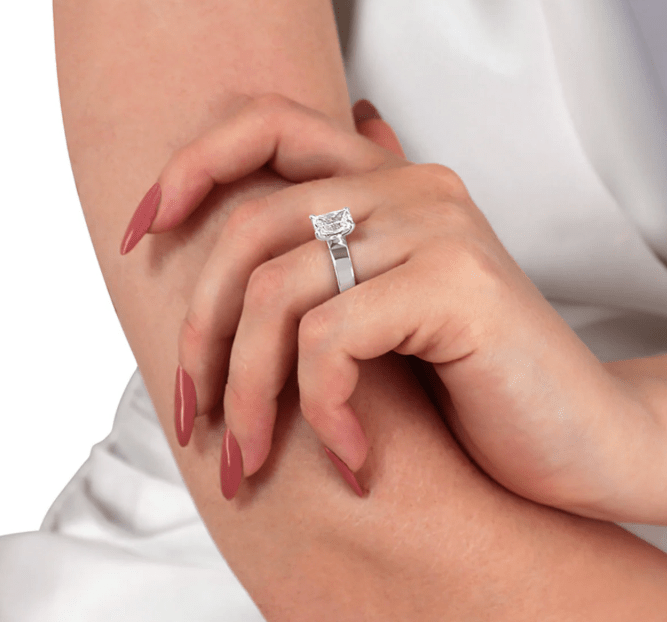
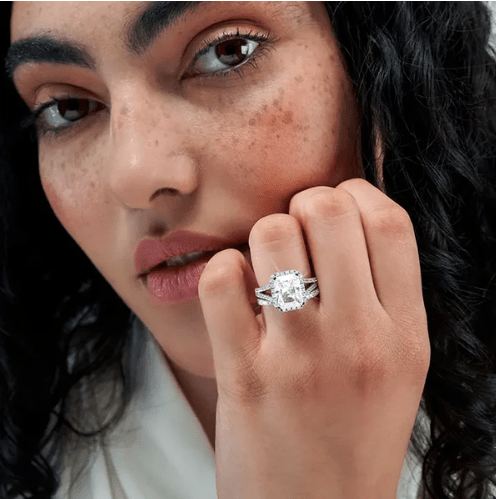
Fashion analysis in Vogue UK has long positioned Chalamet as someone who gravitates towards pieces that feel intelligent rather than ornamental. Translated into jewellery, this suggests a preference for structure and clarity. A step-cut diamond, such as an emerald or elongated Asscher cut, would feel consistent with his aesthetic. These cuts photograph beautifully, feel timeless and avoid the visual noise associated with more traditional brilliant cuts.
For Jenner, the setting would be just as critical as the stone. Her recent jewellery choices point towards refinement rather than maximalism. A clean bezel or a sculptural, slightly wider band could modernise the ring while keeping it wearable and elegant.
The overall result would likely be a ring that feels fashion-forward without being trend-dependent. A piece that signals cultural awareness rather than celebrity excess.
Rihanna and A$AP Rocky
Few couples command as much creative authority as Rihanna and A$AP Rocky. Both have built careers on rejecting convention and reshaping the boundaries of fashion, music and identity. Any engagement ring associated with them would be expected to do the same.
Rihanna’s jewellery history shows a consistent preference for bold, symbolic pieces. However, in recent years, her style has evolved towards confident simplicity rather than layered extravagance. This suggests an engagement ring that is visually striking but not overly ornate.
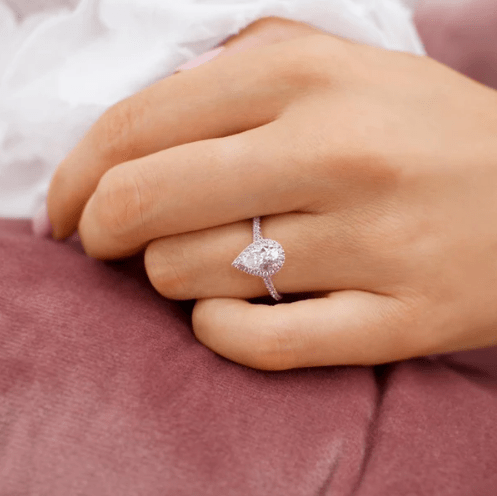
Editorial commentary in Harper’s Bazaar has often described Rihanna’s jewellery as architectural rather than decorative. In practical terms, this points towards a distinctive diamond shape with a strong silhouette. A pear or marquise cut would feel particularly appropriate, offering drama through form rather than embellishment.
A$AP Rocky’s influence could further push the design into unconventional territory. Mixed metals, a thicker band or an unexpected orientation could feature, challenging traditional ideas of femininity in engagement jewellery. The ring might feel closer to a design object than a conventional heirloom.
Rather than being defined by carat weight, this ring would be defined by presence. A piece that reflects two individuals who consistently lead rather than follow.
Bella Hadid and Adan Banuelos
The relationship between Bella Hadid and Adan Banuelos has introduced a noticeably quieter narrative into celebrity culture. Their public appearances suggest a focus on lifestyle, routine and authenticity rather than spectacle. This sensibility would almost certainly carry through to an engagement ring.
Hadid’s recent fashion influence has leaned heavily into understated luxury and archival references. Her jewellery choices often feel personal, timeless and intentionally low-key. An engagement ring in this context would likely avoid overt glamour.
Fashion reporting in The Guardian has explored Hadid’s role in redefining modern luxury through restraint. Translating this into jewellery suggests a softer diamond shape, such as an oval or cushion cut, chosen for warmth and proportion rather than brilliance alone.
A yellow gold band, potentially with a low-profile setting, would align with Hadid’s preference for jewellery that feels lived-in rather than pristine. Banuelos’ equestrian background further supports a design that prioritises comfort and durability alongside beauty.
This type of ring often resonates strongly beyond celebrity culture, influencing buyers who value longevity, subtlety and emotional authenticity over immediate impact.
Katy Perry and Justin Trudeau
A potential engagement between Katy Perry and Justin Trudeau would represent one of the most unusual cultural pairings of the decade. Any engagement ring in this context would carry symbolic weight beyond personal style.
Perry’s jewellery history has often leaned into playfulness and colour. However, her more recent public appearances suggest a move towards refined elegance. Combined with Trudeau’s diplomatic role, this points towards a ring that communicates seriousness without sacrificing individuality.
Cultural analysis in BBC Culture has noted that jewellery associated with political figures often favours recognisable, timeless silhouettes. In this case, a round or oval diamond would feel plausible, chosen for its symbolic clarity.
The modernity would likely appear in the setting. A subtly wider band, a clean bezel or a contemporary proportion could prevent the ring from feeling dated. The overall effect would be one of credibility and balance rather than extravagance.
Such a ring would reinforce the idea that influence in 2026 is as much about trust and consistency as it is about creativity.
Paul Mescal and Gracie Abrams
The pairing of Paul Mescal and Gracie Abrams reflects a softer, more introspective strand of modern celebrity culture. Both are associated with emotional depth and creative authenticity rather than spectacle.
An engagement ring predicted from this relationship would almost certainly reject traditional celebrity tropes. Instead of size or dramatic flair, the focus would be on meaning and proportion.
Music and culture coverage in Rolling Stone has highlighted Abrams’ understated aesthetic and emotional storytelling. Translating this into jewellery suggests a ring that feels delicate but intentional.
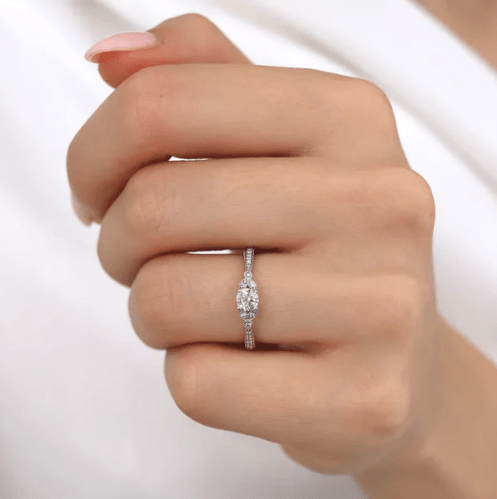
A modest round or oval diamond, selected for brilliance rather than carat weight, would feel appropriate. The band would likely be slim and refined, allowing the stone to sit naturally on the hand. Platinum or white gold could reinforce a sense of quiet permanence.
Mescal’s influence might further simplify the design. The ring could feel almost understated at first glance, revealing its quality through craftsmanship rather than immediate impact. This type of engagement ring resonates strongly with younger buyers who prioritise authenticity over tradition.
What These Predictions Reveal About 2026
Taken together, these predicted engagement rings paint a clear picture of where celebrity jewellery is heading in 2026. The emphasis is no longer on competing displays of wealth. Instead, the focus has shifted towards rings that feel culturally literate, emotionally grounded and personally resonant.
Luxury analysis in Financial Times How To Spend It has repeatedly highlighted that modern luxury consumers value confidence and intention over excess. Engagement rings are no exception. The most influential designs are those that feel aligned with the wearer’s identity and lifestyle.
This broader shift also explains the growing appeal of lab grown diamonds and modern design approaches. Brands such as Lily Arkwright sit naturally within this evolving landscape, offering engagement rings that prioritise design intelligence, ethical clarity and contemporary proportion.
Celebrity engagement rings will always capture attention, but their influence in 2026 feels more subtle and more powerful. Rather than dictating a single ideal, they validate diversity of choice.
The rings most likely to define the year will not be the largest or the most extravagant. They will be the ones that feel intentional, credible and deeply personal.
If these predictions hold true, 2026 will mark a clear departure from old celebrity engagement narratives. Romance will still be celebrated, but it will be expressed through restraint, thoughtfulness and confidence rather than spectacle.
And that shift will likely shape engagement ring culture far beyond the red carpet.
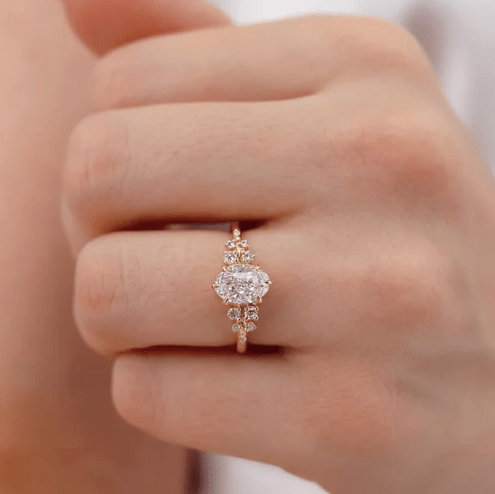
 Diamonds are a girls best friend