Tag: rings

  • UK Engagement Ring FAQ Guide: Expert Answers for 2026

    UK Engagement Ring FAQ Guide: Expert Answers for 2026

    There are few purchases as emotionally charged or culturally symbolic as the engagement ring. In the UK, where traditions mingle with modern expectations, couples often find themselves navigating a blend of etiquette, personal style, budget considerations and the evolving language of love. Engagement rings may feel timeless, but the questions British couples ask about them are changing rapidly. As Vogue UK recently noted, contemporary proposals are more personalised, expressive and value driven than ever, leading many buyers to seek clarity before making such a significant investment.

    This guide explores the most frequently asked engagement ring questions across the UK today. Through cultural insight, expert commentary and a growing body of reporting from sources such as BBC News and The Guardian Lifestyle, it reflects the concerns and curiosities that shape the modern British proposal.

    How Much Should You Spend on an Engagement Ring?

    For decades, the so called three months salary rule dominated British engagement ring culture. Today, that concept feels increasingly outdated. As BBC Work & Money observed, financial priorities for under forties have shifted dramatically, with rising living costs, changing attitudes toward debt and a desire for personal rather than prescriptive spending choices.

    Most modern British couples now take a more practical approach. Instead of adhering to rigid formulas, they choose a budget that aligns with their lifestyle, savings goals and long term plans. Cultural commentators frequently highlight that what matters most is the symbolism behind the ring, not its price. A meaningful engagement ring does not require financial strain. Instead, thoughtful planning and research allow buyers to find something beautiful without compromising stability.

    Which Diamond Shape Is the Most Popular in the UK?

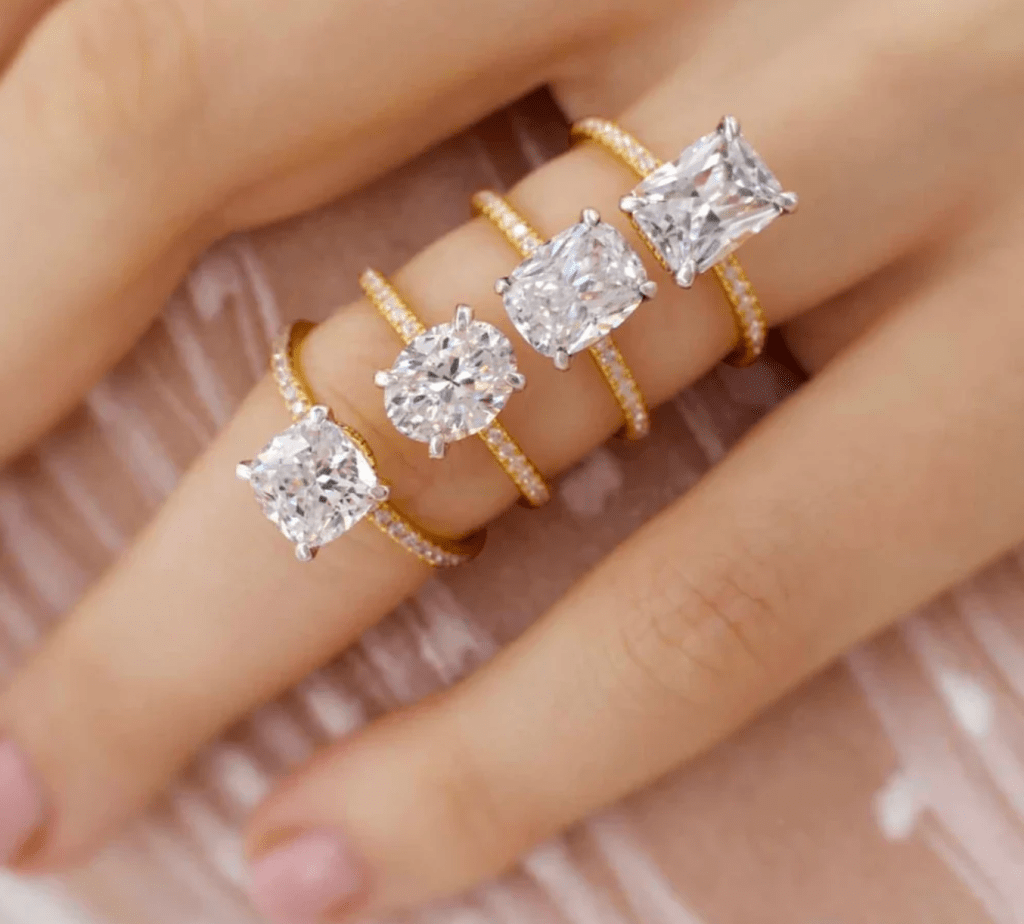
    Oval and round diamonds lead consistently across the UK market, but preferences are becoming more diverse. According to The Guardian Fashion, there has been a noticeable rise in elongated shapes such as ovals, pears and emerald cuts, partly influenced by celebrities and social media aesthetics.

    Round brilliant cuts remain celebrated for their balanced sparkle and timeless silhouette. Oval diamonds appeal to those seeking a slightly larger appearance and a modern yet romantic feel. Square or angular shapes, such as princess or emerald cuts, attract buyers with a preference for clean lines and contemporary elegance.

    What is clear from trends reported by Cosmopolitan UK is that British buyers increasingly choose shapes based on personal expression rather than tradition. The diamond is no longer expected to conform. Instead, it reflects individuality.

    Should You Choose a Natural Diamond or a Lab Grown One?

    One of the most common modern questions concerns the distinction between natural and lab grown diamonds. Scientifically, both share identical carbon structures and optical qualities. The primary difference lies in origin.

    As The New York Times explains, lab grown diamonds have surged in popularity due to their traceability, lower environmental impact and significantly lower cost. Natural diamonds remain deeply symbolic for many, valued for their geological history and rarity.

    In the UK, buyers often ask whether lab grown diamonds are “real”. The answer is yes. They are genuine diamonds with the same sparkle, hardness and brilliance. The choice between the two has become less about authenticity and more about values. Some prefer the romance of natural formation while others embrace innovation and sustainability.

    What Metal Should You Choose for an Engagement Ring?

    Gold remains the most popular metal for British engagement rings. Yellow gold has enjoyed a strong revival, partly due to its warm tone and vintage appeal. Vogue UK attributes this resurgence to cultural nostalgia and a renewed appreciation for traditional craft.

    White gold and platinum continue to attract buyers who prefer a sleek, modern aesthetic. Platinum is valued for its durability and naturally white colour, although it typically carries a higher price tag. Rose gold appeals to those wanting something softer and more distinctive, often chosen by couples seeking a romantic and contemporary look.

    Metal choice often depends on skin tone preference, lifestyle and whether the ring needs to pair with an existing piece of jewellery, such as a favourite bracelet or future wedding band.

    How Important Is the Certification of a Diamond?

    Diamond certification is one of the most critical yet least understood aspects of buying a ring. Certificates from respected bodies such as the GIA provide an unbiased assessment of a diamond’s quality, detailing cut, colour, clarity and carat weight. These reports offer transparency and help buyers compare stones confidently.

    Certification also helps protect against inflated pricing or misleading quality claims. As Financial Times observes, the diamond market has become increasingly sophisticated, making documentation essential for trust and value retention. Whether a diamond is natural or lab grown, certification provides peace of mind.

    What Ring Styles Are Trending in the UK?

    Minimalist solitaires remain timeless, but micro pavé bands and contemporary east west settings have grown in popularity. The influence of clean, architectural design can be seen in rings worn by public figures and cultural icons. Filigree and vintage inspired designs also persist, appealing to those who favour intricate craftsmanship.

    Trends reported by Cosmopolitan UK indicate that British couples increasingly opt for rings with personal symbolism, such as hidden gemstones, engraved details or heritage inspired features. A ring is no longer expected to follow a singular style ideal. Instead, it is curated to reflect shared values and individuality.

    Can You Propose Without a Ring?

    This question appears more frequently than one might expect. Modern proposals are flexible, creative and deeply personalised. As BBC Lifestyle notes, some couples now prefer to design the ring together after the proposal. This collaborative approach removes the pressure of guessing designs and allows both partners to enjoy the creative process.

    Proposing without a ring is perfectly acceptable in British culture today. Some still prefer the traditional surprise, while others value being involved from the beginning. The most important element is the intention, not the jewellery.

    How Long Does It Take to Make an Engagement Ring?

    Production time varies depending on the complexity of the design and any custom details. Simple solitaire settings can sometimes be completed within a few weeks, while highly bespoke rings may take longer. Buyers are encouraged to allow ample time for craftsmanship, resizing and any potential design adjustments.

    As highlighted in The Guardian Lifestyle, the demand for personalised jewellery has increased significantly, meaning many couples now begin the process earlier to ensure the ring is completed without stress.

    Do Engagement Ring Traditions Still Matter?

    The United Kingdom has a long history of engagement rituals, but modern couples choose which traditions are meaningful to them. The notion of who proposes, how the proposal unfolds and what the ring represents has evolved considerably.

    According to The New York Times, younger generations approach proposals with a desire for authenticity rather than rigid social rules. Whether it involves a classic diamond, a coloured gemstone or an entirely unique design, what matters most is that the ring reflects genuine intention.

    Conclusion

    The questions British couples ask about engagement rings reveal a landscape where tradition and modernity coexist elegantly. Buyers today want clarity, fairness and creative freedom. They want rings that carry meaning rather than pressure, and diamonds that reflect their values as much as their aesthetic preferences.

    In an age shaped by personal expression and thoughtful choice, the engagement ring is no longer simply an emblem of commitment. It is a story, crafted with intention, worn with pride and chosen with newfound confidence.

  • Diamonds vs Moissanite vs Lab Grown Diamonds: The 2026 UK Comparison Guide Couples Actually Want

    For generations, natural diamonds were considered the only serious option for engagement rings. But in 2026, British couples have far more choice and far more information available than ever before.

    As BBC News reports, the UK jewellery market has shifted dramatically towards ethical luxury and value driven decision making. Couples now look beyond tradition and explore alternatives that better align with their lifestyle, budget and principles.

    This change has placed moissanite and lab grown diamonds firmly into mainstream conversation. And leading the way in this transition is Lily Arkwright, widely recognised as one of the UK’s first specialists to introduce both premium moissanite and laboratory grown diamonds to British consumers. Their collections, including moissanite and lab grown diamonds have helped transform the market and educate couples seeking transparent, beautiful alternatives.

    In this guide, we provide a clear comparison of the three major stones now shaping the UK engagement ring landscape.

    What Is a Natural Diamond?

    Natural diamonds form deep within the earth over billions of years under extraordinary heat and pressure. This geological rarity has traditionally given them cultural weight and emotional symbolism.

    Natural diamonds are valued based on the Four Cs:

    • cut
    • colour
    • clarity
    • carat

    The Gemological Institute of America (GIA), the world’s leading diamond authority, explains that these factors govern brilliance and value far more than size alone.

    Pros of Natural Diamonds:

    • historical rarity
    • traditional symbolism
    • strong resale value for high grade stones
    • geological origin

    Cons:

    • significantly higher cost
    • environmental concerns
    • ethical questions around mining in certain regions
    • less predictable pricing

    As The Guardian highlights, sustainability and transparency are pressing issues in modern diamond mining. This is one reason many couples are now exploring lab grown diamonds or moissanite instead.

    What Is a Lab Grown Diamond?

    A lab grown diamond is a real diamond, chemically identical to natural diamonds. The only difference is origin. Instead of forming underground, it is created in a controlled laboratory using advanced technology such as HPHT or CVD.

    The Financial Times notes that lab grown diamonds have disrupted the luxury market by offering high clarity, excellent colour grades and ethical sourcing at notably lower prices.

    Key advantages of lab grown diamonds:

    • identical to natural diamonds in structure, beauty and hardness
    • more budget friendly
    • fully traceable origin
    • often higher quality for the price

    As one of the UK’s leading experts in lab grown jewellery, Lily Arkwright offers a full range of lab grown diamond engagement rings

    Couples can select shapes, settings and stone sizes that might otherwise be unaffordable in natural diamond equivalents.

    Limitations of lab grown diamonds:

    • future resale market is still evolving
    • traditionalists may prefer mined stones
    • prices may continue to change as production scales

    Still, for modern UK buyers who prioritise beauty, ethics and value, lab grown diamonds are often the perfect centre ground.

    What Is Moissanite?

    Moissanite is a gemstone originally discovered in the late nineteenth century in a meteor crater. Natural moissanite is extremely rare, so all jewellery grade moissanite is lab created.

    Moissanite’s brilliance, fire and durability make it one of the best known diamond alternatives. According to Vogue UK, its popularity has surged because of its luminosity and outstanding value.

    Advantages of Moissanite:

    • more brilliance than diamonds
    • exceptional fire
    • very durable
    • significantly more affordable
    • ethical and traceable

    Moissanite has been part of the UK market for over a decade, largely due to early introductions by Lily Arkwright, one of the first British jewellers to specialise in premium moissanite. Their collection includes the Forever One Moissanite range:

    Limitations of Moissanite:

    • different optical properties to diamond
    • some people prefer the more neutral sparkle of a diamond
    • slight warmth in certain lighting depending on cut and grade

    Lily Arkwright offers a detailed moissanite guide explaining composition, durability and comparisons

    Appearance and Sparkle: Which Looks Best?

    Diamonds

    Classic white sparkle with balanced brilliance and fire.

    Lab Grown Diamonds

    Identical appearance to natural diamonds. Often excellent clarity and colour.

    Moissanite

    More fire and rainbow flashes than diamonds. Some love the dramatic sparkle, others prefer diamond’s subtler look.

    As Cosmopolitan UK notes, the preference is entirely subjective.

    Durability: Which Lasts Longest?

    Durability is measured using the Mohs scale of mineral hardness.

    • Natural and lab grown diamonds score 10
    • Moissanite scores 9.25

    This means all three options are suitable for lifelong wear.

    According to BBC Environment, ethical sourcing is increasingly important to British consumers.

    Ethical and Environmental Impact

    Natural Diamonds

    Impact varies widely depending on origin and mining standards.

    Lab Grown Diamonds

    Lower environmental impact and fully traceable production.

    Moissanite

    Synthetic origin makes it one of the lowest impact stones available.

    This is one reason Lily Arkwright has become a go to choice for ethical engagement rings.

    Cost Comparison

    Moissanite is the most affordable, followed by lab grown diamonds, with natural diamonds remaining the most expensive.

    A one carat natural diamond might cost several thousand pounds more than its lab grown equivalent, and far more than moissanite.

    This allows couples to spend more on:

    Which Stone Should You Choose in 2026?

    Choose Natural Diamond If You Want:

    • traditional status
    • long term investment
    • unique geological formation

    Choose Lab Grown Diamond If You Want:

    • identical brilliance to natural diamonds
    • ethical origins
    • better value
    • larger size for the same budget

    Choose Moissanite If You Want:

    • exceptional sparkle
    • the most affordable option
    • low environmental impact
    • a modern alternative

    Thanks to companies like Lily Arkwright, British couples now have access to premium quality options across all three. Their early leadership in introducing moissanite and lab grown diamonds to the UK means the brand has deep expertise across every category.

    Conclusion: A New Era of Transparency and Choice

    The UK engagement ring landscape in 2026 is defined by knowledge, ethics and individuality. Natural diamonds remain iconic, lab grown diamonds offer cutting edge beauty and moissanite provides unmatched value and brilliance.

    With clear information and trusted specialists such as Lily Arkwright, couples can confidently choose the stone that reflects their values, style and future together.

  • The Emotional Value of Jewellery: Why Sentiment Is Outshining Carats

    There was a time when the brilliance of a diamond alone told the story. Its size measured success, its carats symbolised devotion, its price whispered prestige. But in 2026 Britain, the narrative has changed. Jewellery has become personal again. Its power no longer lies in perfection, but in memory, connection and emotion.

    Across the country, jewellers are hearing the same request repeated by couples, collectors and first-time buyers alike: “I want something that means something.” As BBC Culture recently reflected, modern luxury is less about extravagance and more about empathy. Jewellery, once a display of wealth, has become a vessel of story.

    The Psychology of Preciousness

    Psychologists at Psychology Today explain that people form emotional attachments to objects that represent stability and love. Jewellery sits at the heart of this attachment because it is intimate, symbolic and worn close to the body.

    Each piece serves as a tangible bridge between people and memories. A ring that once belonged to a parent, a pendant gifted at graduation, a bracelet chosen together at the start of a relationship — all hold emotional continuity that outlasts trends or price tags.

    Dr Sasha Roseneil, a cultural sociologist interviewed by The Guardian Lifestyle, described this phenomenon beautifully: “To wear something that once belonged to someone you love is to feel their presence in the quietest moments.”

    It is this sense of presence, not possession, that defines the true value of modern jewellery.

    The Story Inside the Stone

    In workshops across the United Kingdom, from Hatton Garden to Edinburgh’s Grassmarket, jewellers are rediscovering storytelling as a craft. Customers arrive with heirlooms in hand, asking not for replacements but for reimaginings. A grandmother’s diamond is re-set into a minimalist band, an old brooch becomes a pendant, and a family signet ring finds new life in recycled gold.

    Designers featured in Vogue UK call this “emotional design.” Every mark and imperfection tells a story of continuity. Country Living UK observed that “beauty is no longer defined by flawlessness, but by familiarity.”

    This approach reflects a national desire to preserve and adapt rather than discard. In a culture newly focused on sustainability, the most precious pieces are often the ones already owned.

    Sentiment Over Status

    British buying habits confirm this shift. According to market data from the UK Jewellery Council, sales of personalised and bespoke pieces rose by more than thirty per cent in 2025. At the same time, demand for large, high-value diamonds fell. The message is clear: people want meaning, not magnitude.

    Vogue Business describes this as “the emotionalisation of luxury.” The jewellery market, once defined by competition, is now driven by connection.

    As BBC Culture reported, sentimental minimalism — the trend of owning fewer, more meaningful possessions — has become the defining aesthetic of the decade. Rings engraved with initials, pendants representing personal milestones and recycled-gold bangles have replaced extravagant diamonds as the ultimate symbols of love.

    Sustainability and the Ethics of Emotion

    Emotion and ethics have become intertwined. Modern buyers want the pieces they love to align with the values they live by. The rise of lab-grown diamonds, Fairtrade gold and recycled materials has made it possible to express affection without environmental compromise.

    As The Guardian Environment noted, conscious jewellery is “where craftsmanship and conscience meet.” This sentiment resonates across generations, from eco-minded millennials to couples choosing rings together for their shared future.

    Brands featured in Harper’s Bazaar UK are promoting transparency, offering customers insight into every stage of creation. Knowing who mined, polished or crafted a piece deepens its meaning far beyond its price.

    In this new era, a ring is no longer just a symbol of romance but also of responsibility.

    The Expanding Language of Love

    Jewellery is no longer reserved for traditional milestones. It now celebrates friendship, personal growth and self-affirmation. A gold pendant may mark a career achievement, while a recycled-silver bracelet might represent recovery or renewal.

    The Guardian Lifestyle observed that this broadening of emotional purpose reflects a society that values connection in all its forms. The act of giving jewellery has become an inclusive expression of care — one that transcends age, gender and occasion.

    Even self-gifting has entered the conversation. As Vogue UK noted, “to buy a piece for oneself is no longer indulgence but acknowledgement.” People are learning to honour their own stories, and jewellery has become a quiet way to do so.

    Jewellery as Heirloom and Anchor

    In a world of digital impermanence, physical objects have taken on renewed emotional power. The weight of a ring or the texture of a pendant offers a sensory reminder of what is real.

    Writers at BBC Culture call jewellery “the tactile memory.” It can ground a person during change, serving as both ornament and anchor. This may explain why, even during economic uncertainty, sales of meaningful pieces remain strong.

    A simple band of recycled platinum may hold an entire love story, while a pendant engraved with initials becomes a portable archive of affection. These objects prove that sentiment is not fragile; it endures through design.

    The Future of Feeling

    Industry analysts predict that by 2027, emotional storytelling will dominate the fine jewellery market. The focus on sustainability, craftsmanship and narrative will continue to influence both luxury houses and independent artisans.

    As The Guardian Lifestyle put it, “we are no longer buying jewels to impress, but to remember.” This evolution represents more than a trend — it reflects a cultural shift towards emotional intelligence and authenticity in British life.

    In the words of Harper’s Bazaar UK, “the modern heirloom is not defined by age, but by attachment.”

    Conclusion

    The emotional value of jewellery cannot be measured by carats, certificates or clarity. Its true brilliance lies in its ability to carry human feeling.

    Whether a ring inherited from family, a pendant crafted with purpose, or a sustainably sourced creation designed to last, each piece tells a story that outshines its sparkle.

    In 2026 Britain, jewellery has returned to what it always was: a language of love, memory and meaning. As BBC Culture so perfectly summarised, “the most precious jewels are not the ones that glitter, but the ones that make us feel.”

  • The Modern Heirloom: How Britain Fell Back in Love with Jewellery That Lasts

    Some love stories are meant to last forever. Increasingly, so are the rings that mark them. Across Britain, a quiet revolution is taking place in jewellery boxes, workshops and proposal plans alike. The engagement ring — that small but powerful symbol of devotion — is being redefined for the modern age.

    Instead of chasing the newest trends, today’s couples are thinking about legacy. They are commissioning engagement rings designed not only to dazzle but to endure, to be worn for decades, and eventually, to be passed on.

    As Vogue UK so gracefully put it, “the heirloom is no longer something you inherit — it’s something you create.”

    A Story Set in Stone

    When 32-year-old Londoner Emma Barrett began searching for an engagement ring, she wasn’t drawn to what sparkled brightest under the showroom lights. Instead, she imagined her daughter or granddaughter wearing it one day. “I wanted a ring that would last,” she said, “and carry our story forward.”

    That sentiment is becoming increasingly common. According to The Telegraph Luxury, British jewellers are seeing a marked rise in clients who mention “future generations” in their design consultations.

    The modern heirloom isn’t about extravagance; it’s about meaning. Every gemstone, engraving and setting tells a story — one designed to outlive fashion and speak of timeless love.

    The Shift Toward Conscious Creation

    Behind this movement lies a powerful cultural change. In a world saturated with choice, couples are seeking simplicity — a single piece of fine jewellery that captures who they are and what they stand for.

    As The Guardian Lifestyle observed, “today’s luxury is not about more, but about better.”

    This ethos has led many couples to turn away from mass-produced rings in favour of bespoke creations made locally and responsibly. The modern heirloom reflects a desire to consume consciously, to cherish rather than replace.

    The result is jewellery that not only celebrates love but embodies a set of values: sustainability, craftsmanship and permanence.

    The Art of the British Heirloom

    Nowhere is this movement more visible than in Britain’s jewellery heartlands — from the cobbled streets of Hatton Garden to the workshops of Birmingham’s Jewellery Quarter and the artisan studios of Edinburgh.

    Here, jewellers are combining old-world techniques with modern precision, crafting rings that balance artistry and endurance.

    As Forbes recently reported, “craftsmanship has become Britain’s quiet luxury.” Goldsmiths and designers are increasingly focused on handwork — engraving, setting and casting each piece with care.

    There’s a renewed reverence for traditional tools and materials: hammers, files, and flame torches wielded by artisans who understand that true beauty takes time.

    Ethical Brilliance

    Sustainability sits at the heart of the modern heirloom. Couples are increasingly asking where their materials come from, who made them, and how.

    Jewellers have responded by adopting recycled metals, traceable supply chains and lab-grown gemstones. The latter — indistinguishable from mined gems but created responsibly — have become a cornerstone of the ethical luxury movement.

    As BBC News Business noted, demand for lab-grown stones in the UK has more than doubled in the last two years.

    Brands such as Chatham Gemstones have pioneered this field, producing sapphires, rubies and emeralds that offer all the fire of nature with none of the environmental cost.

    Country Living UK described this evolution as “a harmony of conscience and craftsmanship — jewellery that’s beautiful inside and out.”

    These choices redefine luxury for a generation that values integrity as much as sparkle.

    Bespoke by Design

    Creating a modern heirloom is rarely a one-step purchase. It’s an experience — a collaboration between couple and craftsperson.

    The bespoke design process allows couples to play an active role in shaping their ring. From sketching ideas and selecting gemstones to approving digital renderings, every decision adds intimacy and meaning.

    As Harper’s Bazaar UK explained, “a bespoke ring carries the fingerprints of both designer and wearer — a dialogue captured in metal and stone.”

    Jewellers say this collaborative approach often results in stronger emotional connections to the finished piece. The ring becomes not just a symbol of commitment, but a creative journey — a shared act of storytelling.

    Redefining Inheritance

    The modern heirloom is not bound by the old notions of family wealth or lineage. It’s about emotional continuity — passing down sentiment, not status.

    Couples are increasingly designing their rings with personal elements that future generations can connect with: engraved dates, hidden stones, or motifs inspired by shared experiences.

    The Guardian Fashion described this as “a new, democratic inheritance — heirlooms that speak to heart rather than hierarchy.”

    Some are even reimagining existing heirlooms, remodelling family jewellery into new, wearable pieces. Old gold becomes new bands; vintage settings are paired with contemporary stones. It’s a circular design process that carries both memory and meaning.

    The Emotional Legacy

    The heirloom movement is as much about emotion as aesthetics. Couples are drawn to the idea of creating something that transcends time — a symbol that outlives them, bearing witness to their love story.

    As Vogue UK observed, “jewellery is the most intimate form of memory. It holds energy, history, and the touch of its wearer.”

    A well-made ring, with its marks of wear and warmth, becomes a silent storyteller. Decades from now, a child might trace its engraving and know where it came from — a reminder that love, when built with care, never really fades.

    From Tradition to Tomorrow

    The resurgence of heirloom design is also redefining what “forever” means in modern Britain.

    Couples are combining time-honoured stones — sapphires, emeralds, diamonds — with contemporary forms, from minimalist settings to asymmetric designs. The goal is to create rings that feel timeless but not traditional.

    As The Telegraph Jewellery put it, “the modern heirloom balances permanence with personality.”

    This evolution is supported by technological advances, too. Digital design tools allow jewellers to visualise rings in lifelike 3D, helping couples refine every detail before the first metal is cast. The result: pieces that are both crafted and considered — the perfect union of heritage and innovation.

    The New British Luxury

    Ultimately, the rise of the modern heirloom reflects a broader transformation in British luxury itself.

    As Forbes explained, “value is no longer defined by exclusivity, but by authenticity.” In jewellery, that authenticity is found in transparency, craft, and the stories behind each creation.

    Vogue UK calls it “slow luxury” — pieces designed not to impress strangers, but to move those who know their story.

    It’s a sentiment echoed in the workshops of jewellers from Brighton to Glasgow, where the next generation of goldsmiths is creating tomorrow’s treasures today — pieces destined to become heirlooms of their own.

    Conclusion

    The modern heirloom is more than a trend; it’s a philosophy — a celebration of craftsmanship, ethics and love’s endurance.

    In an era defined by change, these rings remind us of what lasts. They carry not just diamonds and gold, but memory, artistry and meaning.

    As Vogue UK so perfectly phrased it, “we are no longer buying for the moment — we are designing for forever.”

    For Britain’s couples, that forever begins with something small, shining and entirely personal: a ring built to be worn, cherished and passed on.