Tag: finance

  • Modern Gold Sourcing: Why Origin Matters, How Ethics Are Changing and Why Recycled Gold Is Here to Stay

    Modern Gold Sourcing: Why Origin Matters, How Ethics Are Changing and Why Recycled Gold Is Here to Stay

    Gold has always been associated with permanence. It does not tarnish, it resists time and it carries meaning across cultures and generations. In fine jewellery, gold is more than a precious metal. It is the material that holds form, memory and symbolism together. In 2026, however, gold is no longer judged solely by its colour or karat. Increasingly, its origin matters just as much as its appearance.

    This shift reflects a wider change in how luxury is understood. Buyers today are better informed and more curious. They want to know not only what they are buying, but how it was made and what impact its creation had. Gold sourcing has moved from a background detail to a core part of the jewellery conversation.

    To understand why this matters now, it helps to look at gold’s long relationship with human civilisation.

    Gold has been used in jewellery for thousands of years, prized for its malleability and resistance to corrosion. Archaeological research published by the British Museum shows that gold jewellery from ancient Mesopotamia, Egypt and Rome has survived in remarkable condition, reinforcing gold’s association with longevity and continuity.

    Yet while gold’s physical properties are enduring, the methods used to extract it have changed dramatically. Modern gold mining can involve extensive land disruption, high water usage and chemical processes such as cyanide leaching. Investigative reporting by National Geographic has documented how poorly regulated mining can damage ecosystems and affect local communities, particularly in regions with limited oversight.

    As awareness of these impacts has grown, expectations around gold sourcing have evolved. In fine jewellery, permanence is no longer measured only by how long a ring lasts, but by whether the materials behind it can be justified ethically.

    Ethical gold sourcing refers to systems designed to reduce environmental harm, protect workers and increase transparency throughout the supply chain. This includes responsible mining practices, fair labour conditions, safer chemical management and traceability from extraction through to manufacturing.

    One of the most widely recognised frameworks for ethical sourcing is provided by the Responsible Jewellery Council. The organisation sets global standards for responsible business practices across the jewellery industry and offers independent certification covering mining, refining and manufacturing processes.

    In Europe, ethical sourcing is increasingly aligned with broader policy expectations. Guidance from the European Commission highlights growing emphasis on traceability and sustainability across supply chains, including luxury goods. These expectations reflect a shift away from blind trust towards documented responsibility.

    Alongside improved mining standards, recycled gold has become one of the most significant developments in ethical jewellery.

    Recycled gold is recovered from existing sources such as old jewellery, electronic components and industrial waste. Once refined, it can be reused indefinitely without losing quality. Technical information from the World Gold Council confirms that recycled gold is chemically identical to newly mined gold and performs in exactly the same way in jewellery.

    The difference lies in impact. Recycling gold reduces the need for new extraction, cutting down on environmental disruption and energy use. Environmental reporting by The Guardian has shown that recycled gold requires far less water and energy than primary mining and avoids many of the social risks associated with extraction.

    For fine jewellery, this is particularly relevant. Jewellery is designed to last, often for decades or generations. Using existing materials supports that philosophy, reinforcing the idea of longevity rather than continual consumption.

    Modern refining techniques have made recycled gold increasingly viable for high-end jewellery. Research discussed by MIT Technology Review explains how advances in metallurgical processes allow gold to be refined to extremely high purity levels regardless of its original source. Impurities are removed and consistency is restored, making recycled gold indistinguishable from newly mined material.

    This technological progress has helped reposition recycled gold from an alternative option to a mainstream choice.

    Traceability is another area where gold sourcing has evolved. Historically, gold supply chains were opaque, with material passing through multiple intermediaries before reaching jewellers. Today, digital tools are beginning to improve visibility.

    Reporting by Forbes has explored how blockchain and digital ledger technologies are being tested to track precious metals from source to finished product. While these systems are still developing, they represent a significant step towards transparency and accountability in luxury supply chains.

    For many buyers, ethical or recycled gold carries emotional as well as environmental value. Jewellery often marks life milestones, and materials chosen with care can deepen the meaning of those moments. Cultural research from the British Academy suggests that modern consumers increasingly want purchases to align with personal values, particularly when those purchases are symbolic.

    Gold sourced responsibly offers reassurance. It allows wearers to feel confident not only in how a piece looks, but in what it represents.

    A common misconception is that ethical or recycled gold behaves differently from newly mined gold. In reality, once refined, gold’s properties depend on alloy composition, not origin. Educational resources from the Gemological Institute of America explain that yellow, white and rose gold are created by combining pure gold with other metals such as copper, silver or palladium. These alloys determine strength and colour regardless of whether the gold was mined or recycled.

    This means ethical choices do not require aesthetic compromise.

    Contemporary jewellery design increasingly reflects this understanding. Designers are placing greater emphasis on material honesty and longevity, treating gold as a central design element rather than a neutral base. Design commentary from Dezeen highlights how modern jewellery values transparency in materials and process as part of its appeal.

    The wider acceptance of lab grown gemstones has further influenced expectations around gold sourcing. As buyers embrace innovation in gemstones, they increasingly expect the same clarity and responsibility in precious metals. Jewellery is now viewed as a complete system rather than a collection of unrelated components.

    Many modern fine jewellery collections adopt this integrated approach, combining thoughtful gold sourcing with contemporary craftsmanship, as seen in brands such as Lily Arkwright. In this context, gold choice is part of the overall design philosophy, not a hidden detail.

    Another reason gold sourcing matters today is wearability. Jewellery is no longer reserved for occasional use. Ethical sourcing removes hesitation around daily wear. When materials are chosen responsibly, jewellery feels easier to integrate into everyday life.

    Psychological research discussed by Psychology Today suggests that objects aligned with personal values are worn more frequently and kept for longer. Jewellery that feels ethically sound often develops stronger emotional attachment over time.

    Looking ahead, recycled gold is expected to play an increasingly important role in fine jewellery. Industry analysis from McKinsey & Company indicates that circular material models are becoming central to luxury strategies, particularly as younger buyers prioritise sustainability alongside quality and design.

    This does not mean responsibly mined gold will disappear. Ethical mining remains a necessary part of the global supply when conducted under strict standards. What has changed is the expectation that gold sourcing should be transparent, explainable and intentional.

    In 2026, asking where gold comes from is no longer unusual. It is part of making an informed choice. Gold has always symbolised permanence. Today, that permanence extends beyond the finished piece to the systems that produce it.

    Ethical sourcing, modern refining and recycled gold allow fine jewellery to honour tradition while reflecting contemporary values. They ensure that gold remains enduring and meaningful, supported not just by beauty, but by trust.
  • The Most Common Engagement Ring Questions Asked Online

    Why Engagement Ring Questions Matter More Than Ever

    An engagement ring is not merely a piece of jewellery. It is a cultural symbol, an emotional milestone, a promise of future intentions. So it is little wonder that millions of people turn to Google in moments of uncertainty, excitement or quiet anticipation.

    As Vogue UK recently noted, engagement rings have become “the emotional centrepiece of modern romance.” They hold history and personal identity in equal measure, making the buying process feel both thrilling and overwhelming.

    Across the UK, people search for reassurance, symbolism, meaning and style. Every query carries the weight of love, hope and storytelling.

    Here are the most common engagement ring questions asked online, and what they reveal about relationships in 2026.

    “How do I choose the perfect engagement ring?”

    This is the question that dominates the internet, year after year.

    Notably, “perfect” means different things today. For earlier generations, perfection meant a round diamond in a classic mount. In 2026, perfection is completely personal.

    People search for:

    • rings that reflect personality
    • rings that match fashion taste
    • rings that honour shared values

    As Cosmopolitan UK puts it, “the perfect ring is the one that tells your story, not someone else’s.”

    This shift explains why so many couples now favour unique shapes, non-traditional stones and meaningful design elements.

    “Which diamond shape suits them best?”

    This question blends emotion with aesthetics. It is one of the most searched engagement-related queries, often driven by the desire to choose something deeply personal.

    Modern couples want rings that feel expressive, not generic. As Elle UK observed, “a diamond shape has become a love language in itself.”

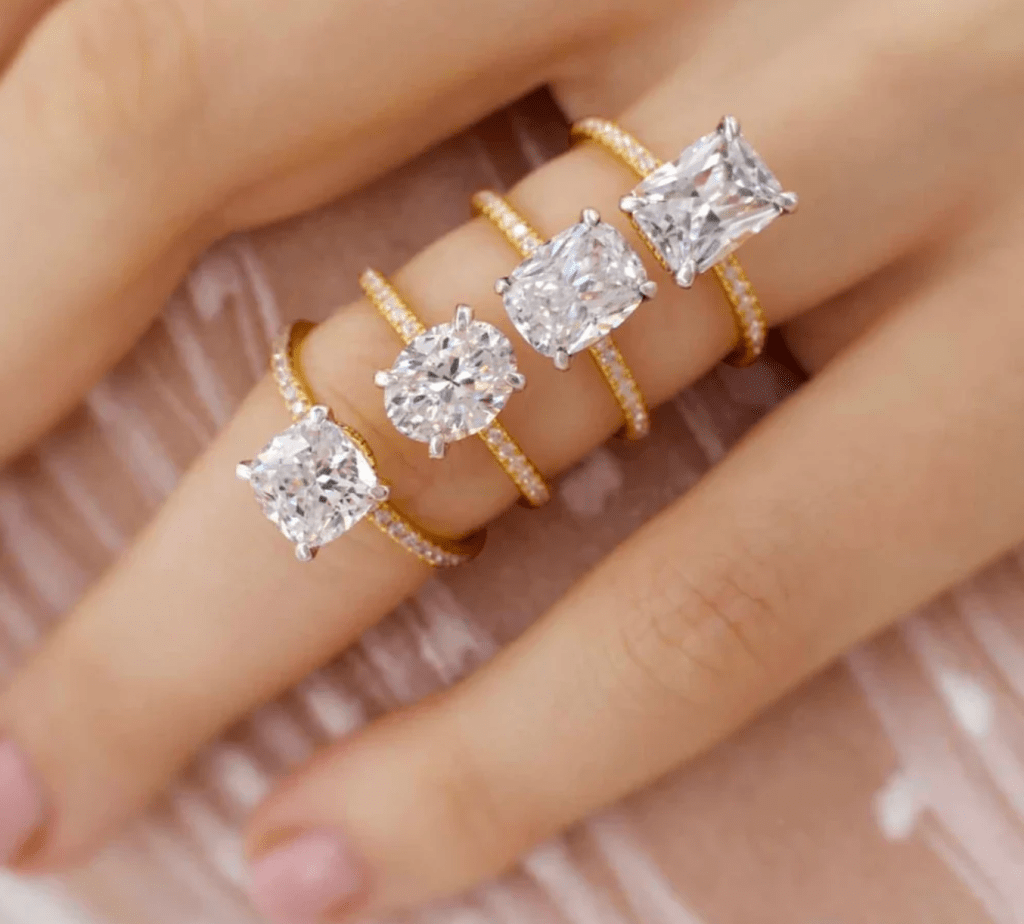
    Each shape suggests a different personality:

    • Oval: graceful, feminine, timeless
    • Emerald: confident, elegant, architectural
    • Pear: romantic, artistic, unconventional
    • Round: classic, balanced, understated

    The question is less about beauty and more about identity.

    “Should I choose natural or lab-grown?”

    This is among the most emotionally loaded questions online today. It is not simply about cost or quality, but about values.

    As The Guardian highlights, sustainability has become a defining priority for British buyers. Lab-grown diamonds offer a transparent, ethical option, while natural diamonds carry historical romance and rarity.

    Search queries reveal that buyers are trying to balance:

    • meaning
    • ethics
    • tradition
    • budget
    • symbolism

    The popularity of this question reflects a modern truth: love today is conscious, thoughtful and grounded in shared principles.

    “What does an engagement ring symbolise?”

    While some ask practical questions, many Google searches focus on emotional meaning.

    Even in 2026, people want to understand the history and symbolism behind the tradition. According to BBC Culture, engagement rings originate from ancient symbolism around eternity and devotion.

    Modern meanings extend far beyond that. Rings now symbolise:

    • partnership
    • equality
    • shared goals
    • independence within togetherness
    • a promise shaped by modern values

    This question shows that buyers care deeply about what their ring represents, not merely how it looks.

    “How do I choose a ring they will love?”

    Perhaps the most sentimental question Google sees.

    The search reveals vulnerability, fear of getting it wrong, and the desire to create a meaningful moment. It is often accompanied by queries like:

    • “Should I ask their friends for help?”
    • “What if they do not like the ring?”
    • “How do I choose without ruining the surprise?”

    As Vogue UK wrote, proposals today are as much about emotional understanding as romance. The ring becomes a symbol of how well you know and honour your partner.

    This question underscores one truth: love makes even confident people second-guess themselves.

    “How much should I spend?”

    The infamous budget question remains unavoidable.

    As Financial Times notes, younger generations reject outdated spending myths. Google searches show that UK buyers prioritise affordability, fairness and shared decision-making rather than traditional guidelines.

    The question reflects changing economic realities and shifting relationship dynamics. Couples prefer financial clarity over performative spending.

    This trend signals a healthy cultural move: engagement rings are an expression of love, not financial pressure.

    “Which metal is the best choice?”

    This question blends practical concerns with aesthetics.

    The most searched metals include:

    • platinum for longevity
    • yellow gold for warmth and resurgence in fashion
    • rose gold for romantic tones
    • white gold for budget-friendly elegance

    As Vogue UK reported, yellow gold has made a major comeback, driven by nostalgia and vintage influence.

    These searches show how fashion trends merge with personal taste to shape one of the most meaningful purchases of a person’s life.

    “What style of ring is trending?”

    A question fuelled by celebrity influence, social media and cultural shifts.

    The most Googled styles in 2026 include:

    • solitaire rings
    • hidden halos
    • antique-inspired designs
    • toi et moi rings
    • coloured gemstones
    • elongated diamond shapes

    As Bazaar UK noted, engagement ring trends reflect broader fashion cycles, particularly the rise of quiet luxury and understated glamour.

    The desire to know what is “in” reveals how modern couples blend romance with cultural awareness.

    “Which rings look the biggest?”

    A surprisingly common question that reveals the desire to balance beauty and budget.

    According to Cosmopolitan UK, elongated shapes such as oval and pear appear larger because they spread weight along the finger.

    This question is less about status and more about proportion, self-image and perceived beauty.

    It shows that people want their ring to feel transformative, not purely expensive.

    “How do I keep an engagement ring a secret?”

    One of the most endearing searches on the internet.

    It reveals the romantic desire to protect the surprise, despite living in a world of shared calendars, shared bank accounts and shared phone notifications.

    Common related searches include:

    • “Where do I hide the ring?”
    • “How do I get their ring size quietly?”
    • “How do I plan a proposal without them knowing?”

    This question speaks to the enduring importance of romance. No matter how modern relationships become, the tradition of surprising a partner remains deeply cherished.

    What These Questions Reveal About Love in 2026

    When viewed collectively, the most searched engagement ring questions online tell a powerful story:

    Love today is intentional.

    Couples seek rings that reflect values, meaning and individuality.

    Love today is informed.

    Search behaviour shows an appetite for knowledge and clarity.

    Love today is equal.

    More couples choose rings together or discuss important decisions openly.

    Love today is emotionally intelligent.

    People care deeply about symbolism, story and fit.

    Love today is modern.

    Ethics, sustainability and personal expression drive decision making.

    As BBC Culture puts it, “modern romance is a blend of feeling and awareness.” The internet has become the place where that process unfolds.

    Conclusion

    Behind every engagement ring question lies a moment of vulnerability and anticipation. People Google in quiet moments, often alone, trying to make choices that will shape their future.

    The most searched questions reflect a generation seeking connection, clarity and authenticity. Whether practical, emotional or cultural, each query reveals the beautifully human experience of choosing a symbol of commitment.

    Engagement rings continue to evolve, but the questions remain deeply rooted in love, identity and understanding. That is why they remain among the most searched jewellery topics online, year after year.

  • The Future of Diamond Certification: Blockchain, Transparency and Traceability

    For decades, the diamond industry has carried an air of mystique. Each stone has its own story, one that spans continents and generations, yet the details of that journey have often remained hidden from view. While buyers have relied on certificates and expert opinion to verify authenticity, the truth behind a diamond’s origin has not always been clear. In 2026, that is finally changing.

    Blockchain technology — once associated only with cryptocurrencies — is now quietly revolutionising diamond certification and traceability. It is bringing transparency to an industry built on rarity and secrecy, offering British buyers a new level of confidence about the gems they choose to wear.

    As Forbes Innovation noted, this shift represents “a digital awakening in one of the world’s oldest trades.” The promise of blockchain lies not in replacing tradition, but in preserving it, ensuring every diamond carries a verifiable story from creation to display.

    The Need for Change

    Diamond certification has long been the cornerstone of trust within the industry. Organisations such as the Gemological Institute of America (GIA) and the International Gemological Institute (IGI) provide detailed grading reports based on the famous four Cs — cut, colour, clarity and carat. These documents have offered reassurance to buyers for decades, establishing a shared language of quality and value.

    Yet even with certification, questions about traceability have persisted. Paper certificates can be lost or duplicated, and once a diamond leaves the laboratory or mine, following its path becomes extremely difficult. The supply chain involves multiple layers of trade, cutting, polishing, and distribution, and transparency has historically been limited.

    In recent years, the rise of ethical consumerism has made this lack of clarity increasingly problematic. British buyers are now more informed and conscientious than ever before, often asking where their diamond originated, who handled it, and how it was mined or created. As BBC Business observed, “paper records are proving inadequate for a market that now demands total accountability.”

    This demand for accountability is exactly where blockchain comes into play.

    How Blockchain Works in Jewellery

    Blockchain functions as a digital ledger — a secure and permanent record of transactions that cannot be altered. Instead of storing information in a single database, blockchain distributes it across a network of computers. Each record, or “block”, is linked to the one before it, forming an unbroken “chain” that makes tampering virtually impossible.

    When applied to the diamond industry, this technology records each stage of a stone’s journey. From the moment a diamond is mined or grown in a laboratory, every event — cutting, grading, sale, or resale — is logged and time-stamped. The information is then accessible through a digital platform, allowing anyone to verify its authenticity in seconds.

    As Financial Times reported, “blockchain does not replace certification; it elevates it.” Traditional grading institutions such as the GIA can now issue blockchain-compatible certificates, embedding technical and ethical details in a secure digital format. This creates a transparent, tamper-proof history that follows the diamond wherever it goes.

    Tracing a Diamond’s Journey

    Imagine a diamond in a London showroom. Its brilliance is unquestionable, but now, with blockchain, so is its past. By scanning a QR code or accessing a digital certificate, a customer can see the stone’s complete journey: where it was mined or grown, the name of the cutting facility, when it was graded, and every point of ownership along the way.

    This digital record turns an opaque industry into one of measurable transparency. As BBC Business highlighted, blockchain “could finally close the information gap that has long defined the global diamond trade.”

    For lab-grown diamonds, this traceability is particularly valuable. Each gemstone’s creation process can be logged from the start, including the type of growth method used and the date of formation. The result is a verifiable account that reassures buyers of both ethical integrity and technical excellence.

    Ethical Confidence for Modern Buyers

    British consumers are at the forefront of ethical luxury. They want craftsmanship, but they also want conscience. As The Guardian Lifestyle noted, “transparency has become the new hallmark of sophistication.” Blockchain technology allows jewellers to meet this expectation by proving their diamonds are conflict-free and responsibly sourced.

    The technology also offers advantages for the growing lab-grown diamond market. Brands such as Lily Arkwright are using digital traceability to provide complete clarity about their diamonds’ origins and grading. Buyers can see not only where and how a stone was made but also the sustainability standards it meets.

    As Forbes Innovation pointed out, this transparency “is creating a new kind of luxury — one built on truth rather than tradition.” Consumers gain confidence in what they buy, and jewellers strengthen trust with their clients.

    How the UK Jewellery Market Is Changing

    Britain’s jewellery industry, worth billions annually, has always balanced heritage with innovation. From Hatton Garden to Birmingham’s Jewellery Quarter, craftsmanship remains at its heart. However, the digital transformation now under way is changing how this heritage is preserved and presented.

    Blockchain technology allows British jewellers to demonstrate integrity without sacrificing artistry. It also offers a competitive advantage, particularly for smaller, independent brands looking to stand out in an increasingly sustainability-driven market.

    According to Financial Times, British buyers now see traceability as a fundamental part of value. A diamond that can be digitally verified commands more confidence — and often higher resale value — because its authenticity is secure and immutable. Insurers and resellers are beginning to rely on blockchain records to confirm provenance, reducing the risk of fraud and misrepresentation.

    For a new generation of British couples shopping for engagement rings, this evolution feels both reassuring and necessary.

    Beyond Diamonds: The Future of Traceability

    Although diamonds are leading this transformation, blockchain is influencing the wider luxury sector too. In fine jewellery, gold and platinum are being digitally traced to ensure responsible sourcing. The same systems are being explored in watchmaking and high fashion to authenticate limited-edition pieces.

    As Forbes Innovation observed, “traceability is the new definition of exclusivity.” In other words, what makes something valuable is not only its rarity but also the integrity of its story.

    This new approach appeals particularly to younger consumers who have grown up in the age of information. They value access and authenticity, and they are willing to reward brands that demonstrate both. In a crowded luxury market, transparency has become a powerful form of differentiation.

    The Role of Lab-Grown Diamonds

    The connection between lab-grown diamonds and blockchain is especially significant. Because these stones are created in controlled environments, it is possible to record every detail of their formation. This aligns perfectly with blockchain’s capacity for precision.

    Institutions such as the GIA have already introduced blockchain-compatible grading systems for lab-grown stones, creating certificates that verify not just the diamond’s characteristics but also its ethical creation. As BBC Science explained, “technology has turned diamonds from natural miracles into measurable works of art.”

    Brands like Lily Arkwright are using these advances to offer clients in the UK the highest levels of assurance. Each ring is accompanied by a fully traceable digital certificate that captures the essence of modern British luxury — understated, intelligent, and responsible.

    Challenges and the Road Ahead

    Although blockchain promises a more transparent industry, its adoption remains uneven. The technology requires collaboration across the global supply chain, from miners and laboratories to retailers and insurers. For small-scale producers, the cost and technical knowledge required to participate can still be barriers.

    There are also questions around data management and governance. Who should maintain these networks, and how can privacy be balanced with openness? Despite these challenges, progress is steady, and the benefits are increasingly clear.

    As Financial Times noted, the transition may take time, but the shift towards transparency is irreversible. The jewellery industry, often defined by tradition, is learning to embrace technology not as a threat but as a safeguard of its legacy.

    Conclusion

    Blockchain technology is ushering in a new era of trust within the diamond industry. It transforms every stone into a story that can be traced, verified, and celebrated — from mine or laboratory to showroom.

    For British jewellers, it represents the meeting point of craftsmanship and innovation. Brands such as Lily Arkwright are showing how technology and artistry can work together to create jewellery that is not only beautiful but also transparent and traceable.

    As Forbes Innovation observed, “the future of luxury is data you can trust.” For the diamond market, that future is already here. Blockchain is giving every gemstone a voice — one that speaks of integrity, sustainability and brilliance in equal measure.